
SpaceX Luna City
Pivot to the Moon will accelerate progress

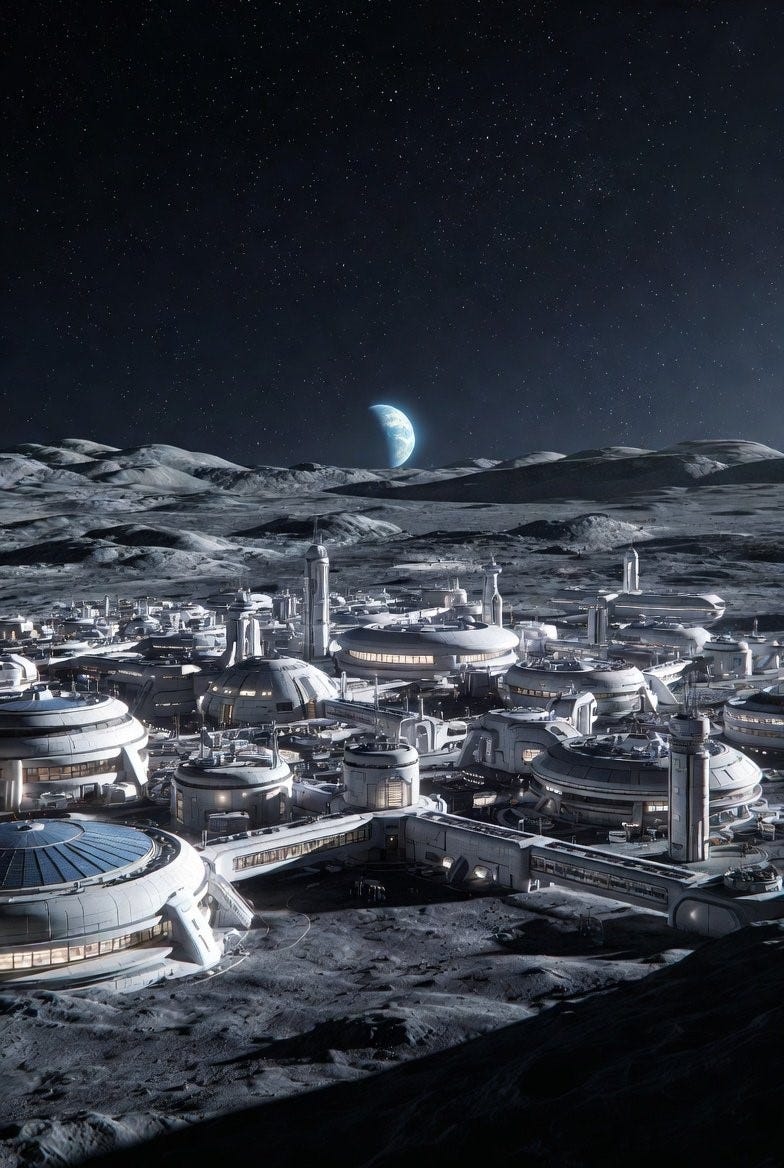
“SpaceX has already shifted focus to building a self-growing city on the Moon, as we can potentially achieve that in less than 10 years, whereas Mars would take 20+ years.” ~ Elon Musk
Since inception SpaceX was always destined for Mars, yet recently they shifted to a moon first strategy. Building a city on the moon is possible with a reusable rocket like Starship, particularly if it achieves a high manufacture and launch rate. This promises to accelerate progress and create a template for the myriad space settlements on Mars and beyond that will surely follow.
Moon Rationale
Building a city on Mars is a truly inspirational goal, but building one on the Moon is more practical for a variety of reasons: -
Chemical propulsion – Mars flights can only depart every 26 months (during the Mars transfer window), and take 6+ months to arrive. Compared to Moon flights which can depart every 10 days and land 2 days later. This will enable the high operational tempo needed to deliver megatons to the moon, as the number of Starships steadily grow.
Solar energy – solar arrays produce 10 times more energy on the Moon than on Earth and 20 times more than Mars. The lunar poles have continuous sunlight, unfiltered by atmosphere or clouds, making solar energy ideal for lunar construction.
Heat management – permanently shadowed craters at the lunar poles have an ambient temperature of -223°C to -248°C which makes them great heatsinks. A lunar city will be power hungry hence fed by nuclear reactors, which overall requires substantial heatsinks.
Propellant production – there are millions if not billions of tons of volatile materials in permanently shadowed craters. Typically these materials consist of frozen water, carbon dioxide/monoxide and methane in surface deposits. Once excavated these materials can be synthesized into rocket propellant, given sufficient power. Then propellant can be stored inside the crater, to take advantage of the cryogenic temperatures.
Abundant resources – surprisingly oxygen is plentiful on the moon, usually bound to elements like silicon, magnesium, iron, calcium, and aluminum. Together these comprise the major elements needed to build a lunar city, and supply local industry.
Mars strategy – the moon will provide valuable experience and the technology needed to go much farther. For example, Mars transport will remain difficult until NASA develop Nuclear Electric Propulsion, which SpaceX will harness to haul more payload to the moon. Overall the cislunar economy should prove profitable for SpaceX, which will help finance Mars settlement.
“We’re still going to Mars and the timeframe for building a self-growing city there is still about the same at 20 to 30 years. It’s possible that revenue from lunar activities might actually accelerate Mars.” ~ Elon Musk
City Construction
“Once you have Von Neumann machines like Optimi on a major mass substrate [like the Moon and Mars], they can convert that local mass to civilization very efficiently.” ~ Elon Musk
Autonomous robots like Optimus can work 24-7 in vacuum and largely immune to swings in surface temperature. Hence legions of them will be exported to the moon to establish surface infrastructure asap. First priority is solar power, then propellant production and a large spaceport. This will allow Starships to return from the Moon for repeat missions, exponentially increasing the payload delivered. When sufficient construction equipment is emplaced, these robots will dig deep to create a network of underground tunnels and caverns. Last step is to install airlocks, allowing these sub-systems to be pressurized ready for habitation. Note: initially Optimus robots will be used to build more Optimus robots on Earth, but when production begins on the moon, more ambitious projects will be possible, such as the planned mass driver...
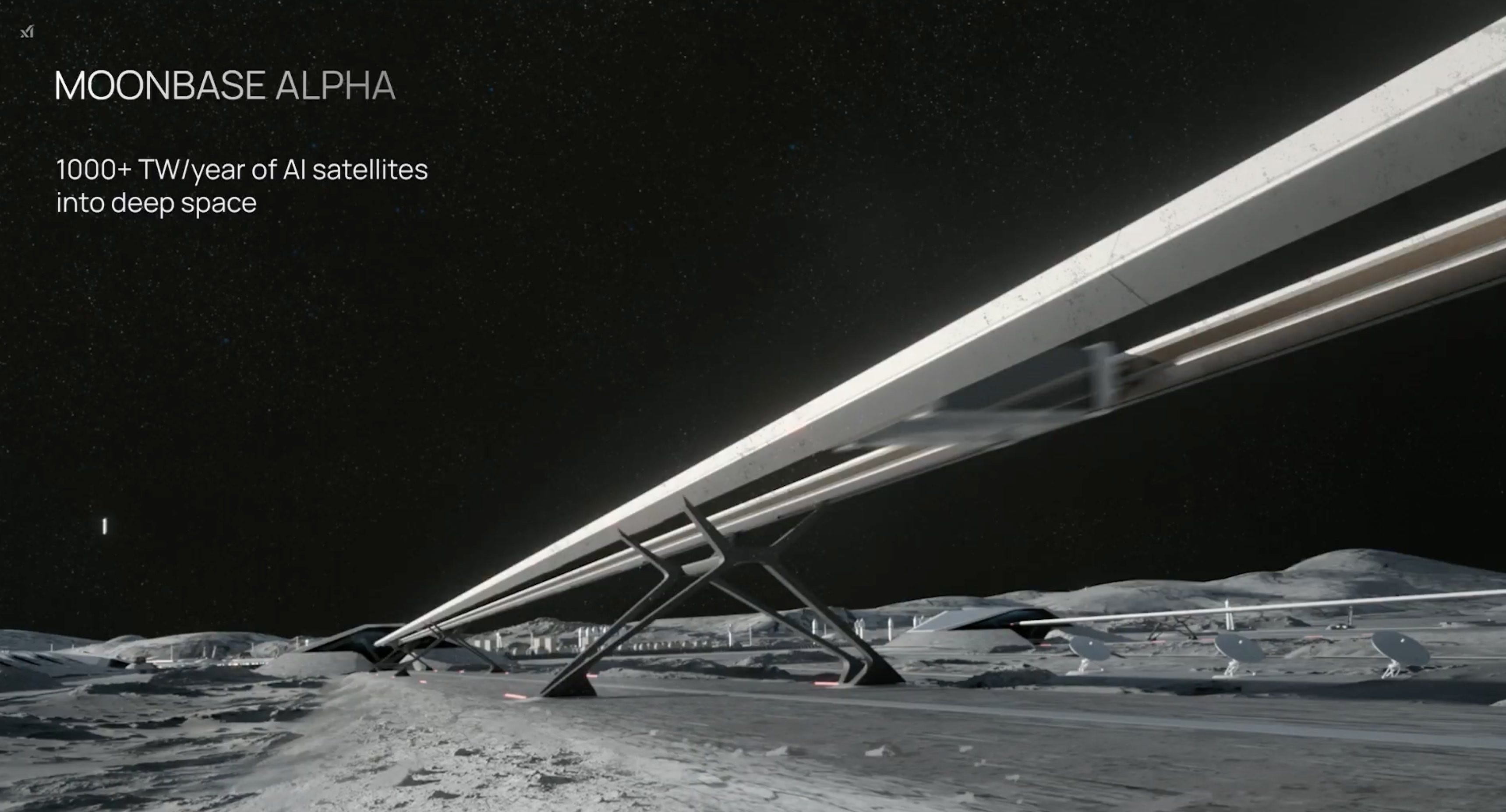
City Plan
Logically Luna City will be located on the rim of a permanently shadowed crater, to take advantage of the continuous sunlight above and volatile materials below. Surface buildings will be used to service construction, maintenance and transport equipment, hence mostly unpressurized.
Musk loves the idea of 3D cities so habitats will likely be located underground, directly beneath these service buildings. Thanks to the Moon’s low gravity, these underground living areas can be cavernous with high arched roofs, able to house thousands of people. Rock walls and roofs offer excellent protection from solar and cosmic radiation and require few construction materials, just electric and data cables plus water and air pipework.
The spaceport will be located kilometers distant, with each pad surrounded by high berms to block ejecta caused by launch and landings. Likely the spaceport will sit on the floor of a permanently shadowed crater, close to the propellant storage tanks. Numerous Starship Tankers can be landed in the crater to create a tank farm then connected to each pad via insulated pipework. Liquid methane and oxygen would normally freeze in these craters, so the launch complex will be floodlit to moderate ambient temperature.
City Life
Starbase Texas could be seen as a prototype for Luna City. It includes a school, medical facility, basic housing, community area, recreation facility and an official police force supplied by Cameron County. Similar amenities should operate in Luna City with policing provided by Space Force, who will have overall responsibility for Moon security. A public park is essential for sports and provide a green space for relaxation. The population would mainly consist of hardcore engineers and frothy tourists making for an interesting dynamic. Housing is fairly basic, similar to Japanese pod hotels, except for the wealthiest tourists and tax exiles.
The US cannot legally own territory on the moon because of the Outer Space Treaty, hence US law won’t apply to Luna City. Expect life there to be highly libertarian except for firearms, due to the danger of depressurization. Taxes of any kind will be avoided because they slow economic growth. Direct democracy will be used for government, to give everyone an equal say – and minimize the number of regulations, due to a need for consensus. City administration would be handled by AI, and far more responsive than what we experience on Earth.
Human work will be high pay due to the difficulty and high skill levels required to oversee construction and create new technologies for local industry. Plenty of spaceport, mining and robotics jobs plus more advanced projects, like far side radio telescopes, AI satellite manufacturing and mass driver construction. Only electronic currency would be used, primarily something like Xmoney, backed by SpaceX. Overall expect a great deal of currency in circulation thanks to long-stay tourism and tax exiles.
In conclusion
NASA made the giant leap to the moon now SpaceX will establish the first foothold in space for all humanity.
“The Moon would establish a foothold beyond Earth quickly, to protect life against risk of a natural or manmade disaster on Earth.” ~ Elon Musk
How long to establish a ‘self growing city’ is moot but more importantly we have committed to it now as a clear and achievable goal.