
SpaceX Nuclear Mission
Nuclear Propulsion brings the moon and Mars a whole lot closer

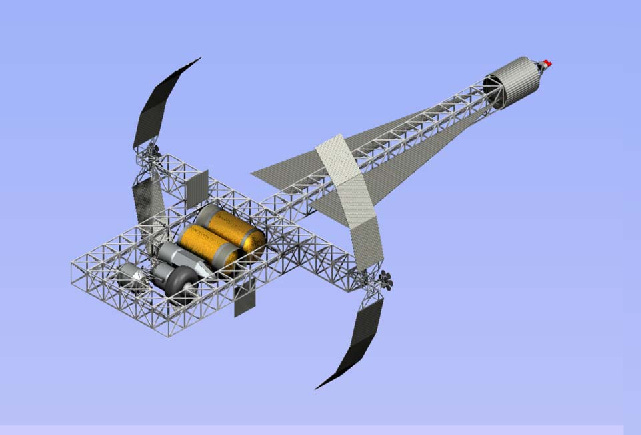
For nearly a decade SpaceX has planned the transition to nuclear propulsion, despite its inherent difficulties.
“We’re actually trying to get hold of some nuclear material [for work on nuclear propulsion] - it’s hard, by the way” ~ SpaceX President Gwynne Shotwell/MIT
Nuclear propulsion is the next step because it’s a more efficient way of converting propellant into thrust. For example: Nuclear Electric Propulsion (NEP) should be 10-20 times more efficient, compared to chemical engines. The nuclear reactor generates electrical power which is fed to ion engines, similar to Hall Effect Thrusters (HET) except far greater thrust. While chemical engines provide more thrust for a short duration, NEP can supply continuous thrust, allowing fast transit to other worlds with comparable payloads. Unfortunately Highly Enriched Uranium (HEU) is required to conserve mass and maximize power output, hence SpaceX’s difficulty obtaining these weapons grade materials. Fortunately NASA’s new administrator has made NEP development a priority, which should help overcome the technical and regulatory hurdles.
“Following a presidential directive, we build a nuclear-powered spacecraft using NEP technology, with the goal of ‘America underway under nuclear power in space’ before the end of the current term. Industry scales proven technologies – thrusters, radiators, structures. power components. The government builds the reactor, integrates the system. and runs ground and in-space operations.” Jared Isaacman, NASA Administrator
SpaceX Go Nuclear
As Isaacman suggests, most of the NEP spacecraft will be produced by industry, hence some involvement by SpaceX seems inevitable for numerous reasons: -
1. SpaceX are the go-to company for commercial spacecraft due to their technical ability and willingness to share cost.
2. An NEP test vehicle would weigh hundreds of tons including propellant. SpaceX Starship can launch 200 tons to orbit, or 300 tons if both stages are expended. In addition Starship can accommodate 8m diameter payloads, plenty of volume for any test vehicle.
3. Isaacman wants to use reliable commercial launch vehicles for all NASA missions. Starship should have completed hundreds of commercial flights when they are ready to test NEP, hence proven reliable.
4. The NEP spacecraft will require more propellant after each test flight and SpaceX should demonstrate orbital refilling with Starship in 2026.
5. Jared Isaacman flew with SpaceX on the Inspiration4 and Polaris Dawn missions, in other words he trusts them with his life…
Realistically SpaceX is unlikely to receive a contract to build the reactor, but everything else is fair game.
Technology and Timelines
Currently 50 megawatt nuclear reactors are used on nuclear submarines, which gives NASA a good place to start. Given Isaacman’s experience with SpaceX he will likely form a small team to develop the NEP reactor and allow them full autonomy. Ideally a test reactor could be ready in 2-3 years, along with ancillary equipment, assuming they are purchased at fixed price from commercial companies. After the NEP engine is proven, NASA can develop a vehicle with multiple engines to haul at least 200 tons of payload.
However, the cislunar economy will demand far more payload in the following decade, so they will need to build a larger spacecraft with more powerful engines. An advanced miniature reactor can generate up to 500 megawatts of electrical power (equivalent to 670,000 horsepower), which could propel a colossal NEP spacecraft. By this time SpaceX should have produced an 18m diameter Starship with quadruple the payload, putting them in pole position to launch the heavier spacecraft modules.
Cislunar Economy
“We are going to build a Moon base” ~ Jared Isaacman/X
NASA can build a lunar base with HLS Starship but they need to convey far more people and cargo to create a cislunar economy. A full scale NEP spacecraft could reach the moon in less than a day carrying thousands of people or numerous cargo containers. Once in low lunar orbit they can be shuttled to and from the surface on HLS Starships, using locally produced propellant.
“NASA focuses relentlessly on achieving the near-impossible-doing what no other agency, company, or nation can accomplish. When achieved, those capabilities are handed off to commercial providers” ~ Jared Isaacman, NASA Administrator
After NASA develop NEP, they want reliable commercial companies to use it. This will lower transport cost and allow a cislunar economy to grow organically, through commercial space operations. Of course this constitutes a huge opportunity for SpaceX to accelerate their business plans for the moon: -
“They [SpaceX] have a lunar business development manager who I have met with a few times. He told me in 2023 that SpaceX plans to stay on the Moon” ~ Phil Metzger/X
And more recently Elon Musk confirmed they have serious plans for the moon: -
“SpaceX will lean in big on the Moon” ~ Elon Musk/X
However, knowing Elon, they will pursue Mars landings in parallel with the moon, despite the inherent difficulties using Starship (e.g. 6+ Starship flights required for each Mars mission).
Mars Needs Nuclear
To create a self sustaining settlement on Mars SpaceX will have to transport hundreds of thousands of people and millions of tons of cargo. Currently they plan to scale up Starship production and launch 1,000 ships to Mars each synod, i.e. every 26 months. Around 99% of these vehicles will remain on the surface because more goods and people will be sent to Mars than return to Earth. SpaceX pride themselves on reusability, so it’s just a question of time before they use it for Mars.
A full scale NEP spacecraft should allow them to transition to full reusability and significantly accelerate the settlement process. For example: the NEP spacecraft could ferry between Earth and Mars orbits on a monthly basis, thanks to the massively powerful nuclear engines. Then goods and passengers could be shuttled to and from the surface similar to the moon, using a Mars version of the 18m ship. Cargo could even be dropped from orbit using a scaled up version of the Project Starfall capsules being developed by SpaceX.
Interestingly, adopting NEP has a second order advantage for SpaceX, that’s difficult to ignore.
“You need a nuclear reactor for power, heat, the ability to melt water, the ability to do electrolysis on the water to get oxygen out.” ~ Adam Lichtl, PhD, former Director of Research at SpaceX
If SpaceX use an NEP reactor to supply grid power on the surface, it will allow the settlement to expand exponentially. Sunlight is roughly half as intense on Mars due to the distance from the sun, so finding a suitable alternative to solar power is necessary for the settlement to scale.
In Conclusion
Nuclear Electric Propulsion is a godsend for SpaceX. Starship is great for pushing payload to orbit and NEP can quickly transport it to new worlds at relatively low cost, overall the perfect synergy of technologies.
SpaceX prayers have been answered with the appointment of Jared Isaacman, who understands what they are trying to build. The NASA-SpaceX partnership has been amazing so far but NEP will take it to the next level.