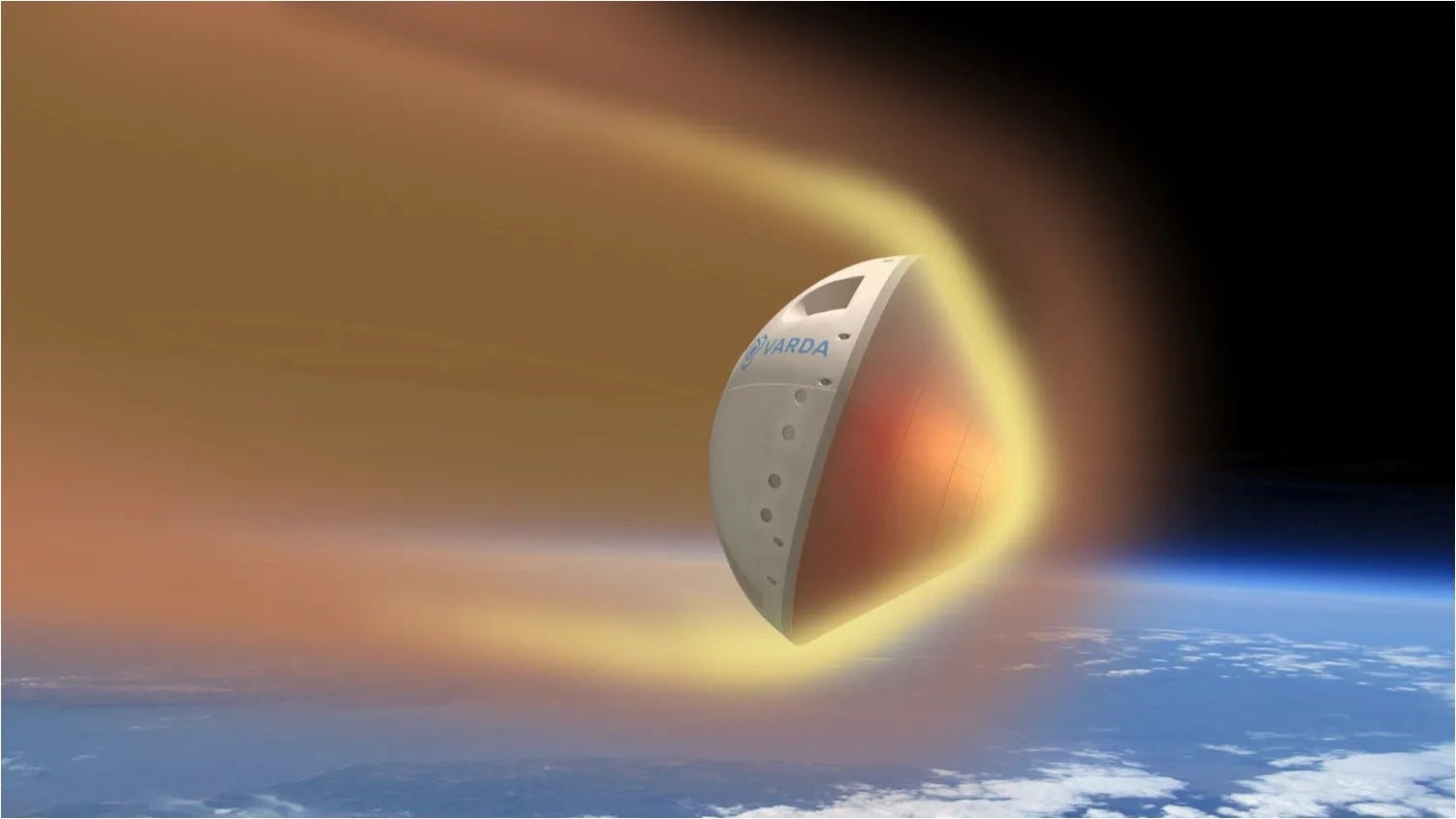
SpaceX Project Starfall
Goods from space make no sense – until it does
Recently it was revealed SpaceX has begun a new development program, called Project Starfall. Reportedly they are developing uncrewed capsules for space manufacturing, which can be launched by their new Super Heavy Lift (SHL) Starship. This should allow sufficient time for goods to be manufactured in space, after which the capsules would land autonomously on Earth.
SpaceX has a history of envisioning new space opportunities then going all out to achieve them, yet Starfall seems their boldest business venture yet. Starship should reduce payload cost by 2 to 3 orders of magnitude but any orbital manufacturing process needs to be highly automated and compact, which significantly adds to cost. Implicitly the goods produced must be high demand, to close the business case.
Manna from Heaven
Like any new technology it is difficult to predict all the applications before it becomes widely available. However, many applications are already being explored, with some leading candidates:-
Pharmaceuticals – virtually perfect crystals can be grown in microgravity, allowing more concentrated drugs to be manufactured. These are particularly effective for immunotherapy treatments used to combat cancer.
Optical Fiber – creating an optical fiber that is effectively one crystal, with minimal defects or impurities, would significantly increase transmission speed and reduce signal loss. Undersea cables require amplifiers at regular intervals to boost signal, which are expensive to setup and maintain. Using a space manufactured fiber like ZBLAN could virtually eliminate these operating costs.
Human Organs – organs manufactured on Earth tend to collapse under their own weight before they mature (without employing dubious cloning techniques). However, organs bio-printed in microgravity have little weight so should achieve ideal form and functionality. Replacement organs are expensive (a heart costs ~$1m, liver $557,000, kidney $262,000), so space manufacturing should be commercially viable if these organs can be produced at reasonable cost.
“The World Health Organization estimates around 130,000 organ transplants take place each year, but this meets just 10% of the transplant need. In the US alone there are 107,000 patients on transplant waiting lists." ~ BBC
Why Starship
“There are long queues to get space on board a rocket to take material to the ISS, and it’s unsurprisingly expensive.” ~ Wired.com
SpaceX already operate Dragon, an autonomous capsule to carry cargo and crew to the International Space Station (ISS). Previously they offered a specialized version of Dragon for space research/manufacturing, called DragonLab, although there was insufficient customer demand for it to enter service. Essentially Dragon was too expensive for startups and offered 37m3 of pressurized and 10m3 unpressurized volume, far more than actually needed for early trials.
Ironically Starship’s cargo bay is 1,000m3 in volume, and can lift 10X Dragon’s payload. However, that means Starship could carry swarms of Starfall capsules to spread the launch cost. SpaceX already offer rideshare launches on Falcon 9 (i.e. regular Transporter and Bandwagon missions), for small satellite operators, so encapsulating customer payloads seems the next logical step. Of course Falcon 9 could also be used to launch a handful of capsules, except Starship has significant economies of scale, making it more practical in the long run.
Currently SpaceX can launch a Falcon 9 every 9 days by reusing the booster, but Starship promises to launch every day because it’s fully reusable. Hence a single Starship could carry thousands of capsules to space every week, assuming they find sufficient customers.
Why Capsules
While more customer payloads could be accommodated in Starship’s cargo bay if they weren’t encapsulated, some manufacturing processes will take longer to complete than others, which would delay the return of Starship. Unfortunately some payloads will be time critical, such as replacement organs, so individual return capsules seem the best solution, considering they could land anytime and anywhere on Earth.
Starfall capsules can be any size, pressurized or unpressurized, solar or battery powered, to suit customer requirements. Likely the entire swarm would be managed by a single AI to further reduce operating cost. No doubt some customers would require more time in space than others, which should be possible with separate autonomous capsules. When ready to return the capsule could use hypergolic thrusters to deorbit and soft land, a technique developed for Dragon in case of parachute failure.
Reusability is the watchword at SpaceX because it makes space more accessible and affordable. Hence Starfall capsules are unlikely to use parachutes because they are normally replaced after each mission. Likewise the heatshield will likely be reusable, similar to Starship, so the capsule and manufacturing equipment can be used for repeat missions, to save on cost.
Essentially these low cost capsules are designed to give startups a leg-up to begin their production tests in space. Then when they are ready to scale-up production they can lease a whole Starship, and fit it out for longterm manufacturing. Starship is so large there are few customers who require that amount of capacity, so Project Starfall could be seen as a feeder program to generate more commercial customers for Starship.
Military Interest
“Starfall also has defense applications, and SpaceX is working in conjunction with the military on the program.” ~ LA Times
The US military are studying Rocket Cargo Transport, and want to use Starship to deliver military materiel anywhere on Earth. Unfortunately if Starship lands near front line forces it would likely be lost, because it couldn’t be refueled for a return flight or transported across country to a suitable port. However, this materiel could be delivered on Starfall capsules, which offer a number of advantages: -
1. Starfall capsules should be relatively inexpensive and easier to recover than Starship.
2. Starship could deploy capsules in different orbital inclinations allowing them to descend to different locations along the front.
3. After Starship deploys all capsules it could return to base and fly again in little more than a day, effectively creating a conveyor belt for materiel to the front.
The military has even discussed prepositioning materiel in orbit to speed up delivery, which should be possible with Starfall capsules. And if the materiel isn’t needed at the front, the capsule can land at Starbase or Cape Canaveral, ready for reuse somewhere else.
Drop Pods
Once capsule technology is proven it could be used to deploy combat troops. Transport ships are slow and can be targeted by a variety of systems (mines, submarines, aircraft, guided missiles etc) making them outdated for a high intensity conflict. By comparison an 8m diameter capsule could carry 25-50 troops and land them within spitting distance of the front, before opponents knew they had even launched. The capsule would reenter at ~Mach 25 and stay supersonic until relatively close to the ground, giving air defenses little time to react. In addition, the capsule would be surrounded by ionized plasma during reentry, making it invisible to tracking radar, further reducing reaction time.
The modern battlefield is extremely dangerous due to targeted munitions and drones, which means defensive troops have to be dispersed to reduce casualties. However, troop concentrations are still required for offensive operations or to halt enemy advances. Assault capsules would be ideal for either operation because they could land with little warning and allow troops to attack from unexpected directions, effectively a quadruple force multiplier.
In Conclusion
Like everything SpaceX does, Project Starfall appears highly strategic. They intend to help small startups evolve into big space manufacturers, capable of exploiting the huge launch capability of Starship.
Prudently SpaceX enlisted military support for this project, to provide a more diverse and resilient customer base. Overall SpaceX has created a tech accelerator for the space economy – and given possible aggressors another reason to pause.


Drop capsules full of robotic shock troops can appear anywhere in the world within 40 minutes, faster if deployed from orbital garrisons.
I'm missing something here. Why is this better? The goods will weigh the same, so the cost to get them into space is no different; however, now you have the weight of the device to make them as well?.
Unless the unit can create things on demand, it doesn't know what is required until told to do so down the line. Like 3D printing but on a multi-material level, plastics, metals, circuits etc.