
New Space Economy
Our space future fast approaches on commercial wings

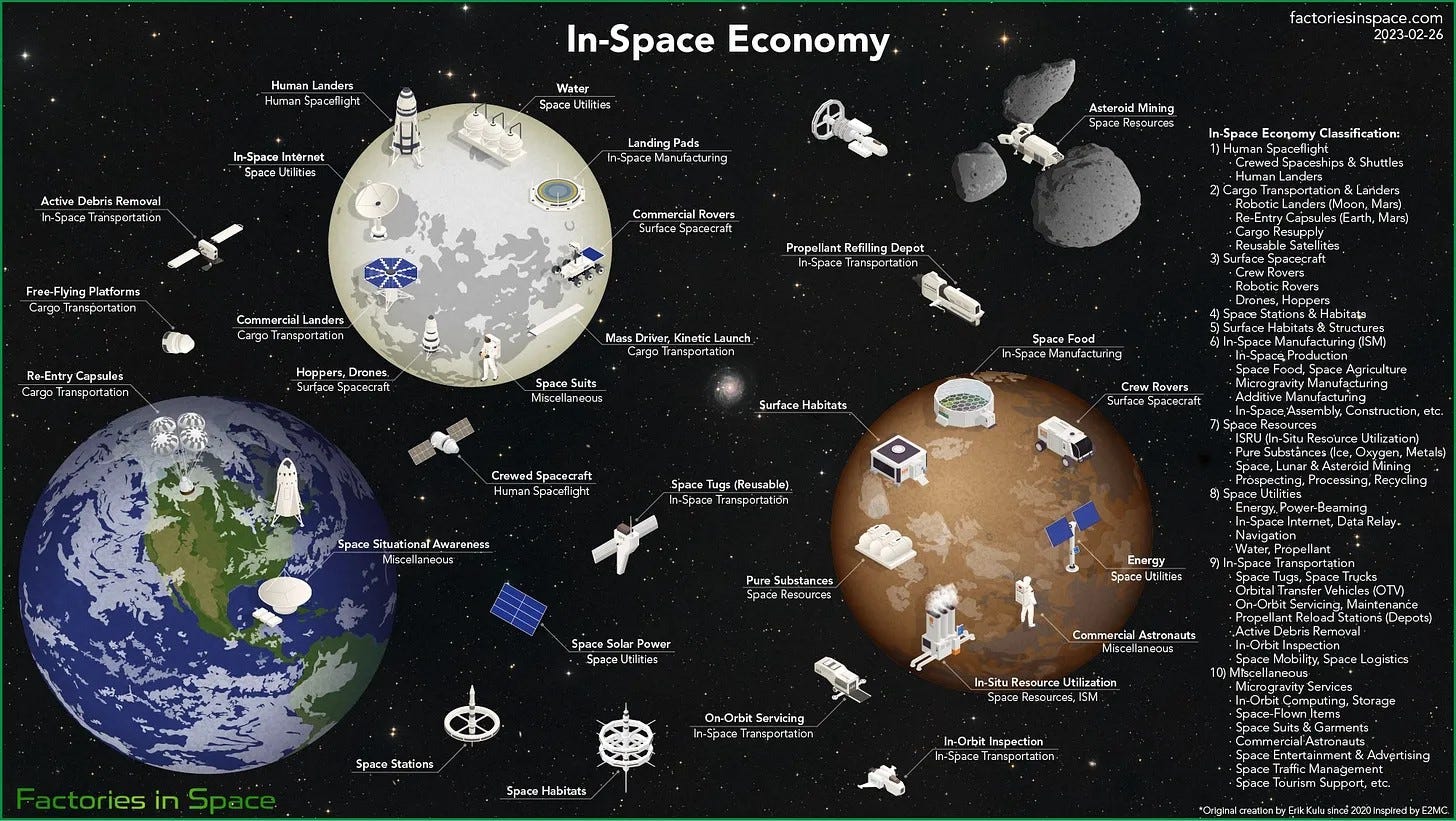
Space has unlimited energy, materials and room to grow, a shining promise soon to be fulfilled. Government has successfully trailblazed space, allowing the unparalleled resources of commercial space companies to capitalize on this unrivaled opportunity.
“SpaceX is rebuilding an improved version of the entire Internet in space... NASA revenue this year is only ~5% of SpaceX’s total revenue.” ~ Elon Musk
Supply and Demand
With all space has to offer, demand will always outstrip supply. However, reusable launch vehicles can supply cheap space access, and stimulate demand for all manner of space products. For example, Starlink satellites can now supply good connectivity for computers and phones anywhere on Earth, taking satellite comms to the next level, thanks to reusable Falcon 9 rockets.
Currently tech companies are engaged in an AI arms race, with devil take the hindmost when demand for electricity exceeds supply. Hence orbital data centers, consisting of constellations of laser interlinked satellites, will become the next big commercial project because of endless AI demand. Orbital space has abundant electrical power, with temperatures close to absolute zero for system cooling, making it the ideal operating environment for high performance AI chips.
“Annualized rate of 100GW/year of space AI satellites launched from Earth in 3 to 4 years.” ~ Elon Musk
Similarly some pharmaceuticals, semiconductor materials and transplant organs can only be made in microgravity, so expect numerous space fabrication facilities to appear within a decade. Last but not least, SpaceX want to send hundreds of Starships to Mars at once, which will require hundreds of orbital propellant depots, essentially one depot for each ship.
Giant Leap
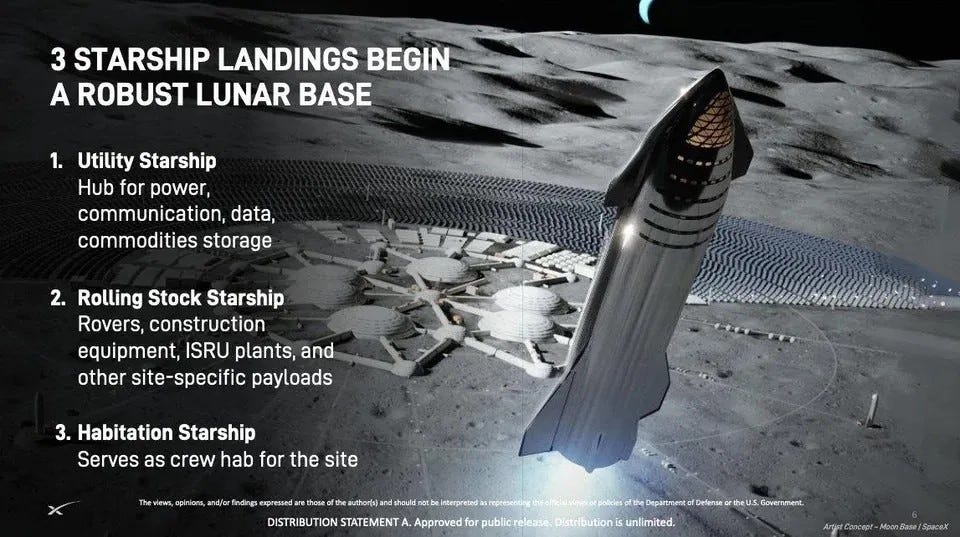
Blue Origin has long planned to commercialize the Moon, with SpaceX joining the effort after winning the first Human Landing System (HLS) contract. Reaching the Moon is expensive, even with giant reusable vehicles like New Glenn 9x4 and Starship V4 produced at scale. However, lunar transport costs will rapidly reduce after these companies invest in surface infrastructure.
Joint Moonbase – NASA wants an enduring presence on the Moon, so aim to build a permanent lunar base. No doubt they will seek commercial partners to share costs i.e. space companies who need a base to build their own lunar infrastructure. Hence NASA will effectively subsidize lunar transport and infrastructure costs during the commercial setup period.
Propellant production – should be possible at the lunar south pole, where there are substantial reserves of frozen water and carbon dioxide/monoxide to synthesize rocket fuel. Currently NASA is developing surface nuclear reactors to supply their Moonbase, which could also power the energy intensive mining and propellant production process. Hauling propellant all the way from Earth is expensive and inefficient, hence producing it on the Moon should reduce lunar transport cost and allow heavier return payloads.
Mass Driver – next step is to build an electromagnetic cannon to launch payloads from the lunar surface. This kilometers long coil gun could fire satellites into solar orbit, allowing terawatts of AI to be deployed at a fraction of the cost compared to launch from Earth.
“100TW/year [of AI satellites] requires manufacturing satellites on the Moon at massive scale that are shot into deep space with a mass driver, which is 10+ years away.” ~ Elon Musk
Dig Deep
While some infrastructure must be built on the lunar surface for comms, solar power, launch and landing, the majority of infrastructure will be built underground. Caverns can be pressurized and offer excellent protection from solar radiation, with interconnecting tunnels to provide modular safety. No doubt the mass driver could be built in a tunnel, similar to CERN, except a straight tunnel leading to the surface.
Metallic asteroids have impacted the Moon for billions of years, suggesting millions of tons of noble metals and rare earths can mined from the lunar surface. These materials could either be used locally to construct infrastructure and satellites or loaded into the mass driver for return to Earth. SpaceX are developing atmospheric entry capsules, to return space manufactured goods, which could equally be used to return lunar materials.
The Department of Energy has already contracted Interlune to return helium 3 from the Moon, due to huge demand on Earth. Currently helium 3 is worth ~$20bn/ton, primarily because it is used to cool quantum computers and develop clean nuclear fusion.
Deep AI
Reportedly Elon’s interest in quantum computing has increased, following recent technical advances. Unfortunately qubits can easily lose their quantum state due to heat, vibration and radiation, fortunately Elon has envisioned a possible solution.
“Quantum computing is best done in the permanently shadowed craters on the Moon” ~ Elon Musk
A cavern beneath a lunar polar crater would have extremely low temperature/vibration and minimal radiation due to shielding from the water bearing strata, making it the ideal environment for quantum computers. These more subtle computers can solve complex optimization and simulation problems so they complement silicon AI computers which are better suited to inference work. Overall combining the sheer computing power of AI with the intuitive ability of quantum computers appears the most practical way to create the first Artificial Superintelligence (ASI)...
Cislunar Economy
Expect small nodes of space infrastructure to spring up, connected by all manner of transport. For example, helium 3 mining will occur at median latitudes on the near side of the moon, then the liquefied gas will be transported overland to the South Pole for shipment to Earth, until they manage to construct a lunar mass driver. Conversely mining of noble metals should occur on the far side of the moon, because its terrain is ancient, hence more likely to contain surface deposits of metallic asteroids. However, refined products will have to be flown to the South Pole using hoppers, due to the ruggedness of the terrain.
Earth orbit will teem with satellites, microgravity manufacturing facilities and propellant storage depots, serviced by inter-orbit tugs and shuttles. While automata are ideal for most space work, there’s no substitute for highly skilled humans. Fortunately they won’t have to be supermen test pilots like the early astronauts because modern launch vehicles are fully automated and have moderate g-loads, similar to the Space Shuttle.
Succinctly: if you can ride a roller coaster you’re fit for space.
In Conclusion
When taken in whole, a sizable space economy will stretch between Earth orbit and the Moon’s subsurface. This new space economy will be driven by commercial demand and made feasible by the supply of low cost reusable spacecraft.
While Mars is a longterm project, the cislunar economy is there for the taking. Free energy, orbits, territory and materials will produce a cislunar gold rush, open to anyone with suitable skills and high ambition.