
NASA Renaissance
Stars align to fulfill NASA destiny

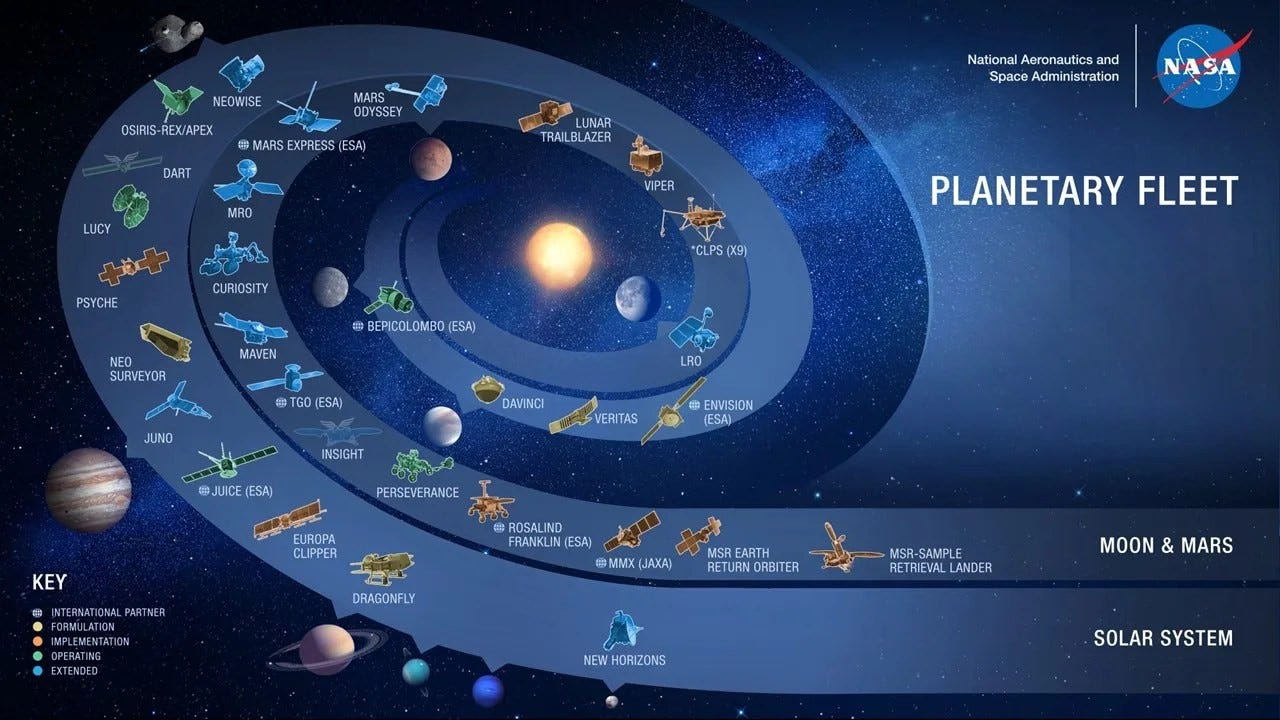
In the nineteen sixties NASA was destined to explore the solar system and far beyond, like a living incarnation of Starfleet. Times change but hope remains and now NASA is finally finding its feet. Similar to the classical renaissance their renewed success is due to a confluence of factors, both internal and external, with more to come in the near future.
Foundation Building
NASA has long been starved of funding, forcing them to delay and cancel projects to their own detriment. Now their budget has substantially increased, mainly due to supplemental funding for manned spaceflight.
“Congress has officially passed a budget that restores critical science missions and pushes the agency’s effective funding to nearly $27 billion.” ~ Astronomy.com
How NASA spends money has also improved, thanks to their new administrator Jared Isaacman. He streamlined internal organization, and accelerated delivery from legacy aerospace companies through to startups. Lastly the administration has set more achievable goals, like docking Orion with Starship in Low Earth Orbit (LEO) for the Artemis 3 mission, to prove these systems are compatible before sending them to the Moon. Art 3 will also test whether Starship can boost Orion to a higher orbit, and if successful Falcon Heavy could launch Orion to LEO then use Starship to push it to Low Lunar Orbit (LLO). Not relying on a single launch vehicle, i.e. the Space Launch System (SLS), is eminently practical considering their recent experience with New Glenn.
Moon First
NASA wanted to build a moonbase after the Apollo landings, and now well on their way to achieving this lofty goal. A host of commercial landers should descend on the Moon in 2027, to deploy rovers and instruments on the surface, followed by at least one human landing mission in 2028, to prepare ground for the base. SpaceX aim to build satellites and a mass driver on the Moon, which will require a substantial settlement, so they will add their considerable resources to NASA’s efforts.
“I think SpaceX might be able to reach approximately $1T revenue in 2030...and I would be surprised if revenue is not greater than $1T in 2031.” ~ Elon Musk/X
Mars Up
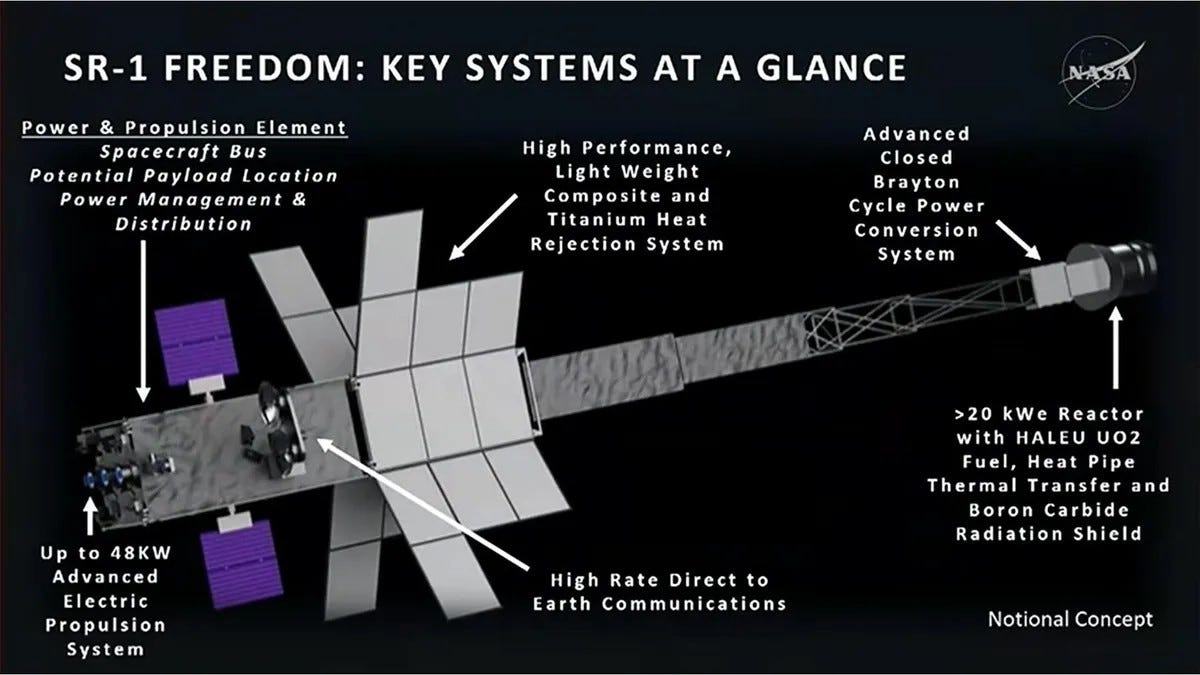
NASA believes Mars is too distant for chemical rockets, hence pursuing Nuclear Electric Propulsion (NEP) in advance of human missions. Their first NEP spacecraft, called Space Reactor One (SR-1) Freedom, should launch for Mars in 2028 to prove fast transit is possible. Then three drones will be released into the atmosphere to scout landing sites for a follow-up crew mission. Developing NEP spacecraft is a major advance, potentially opening the entire solar system to human exploration. Missions to the outer solar system could last years or even decades thanks to the reactors sustained power and efficient electric propulsion.
Human Factor
No-one has transited deep space for more than a few days duration, so NASA needs to mount a series of missions to determine the longterm effects, before they venture farther into the solar system. Fortunately SpaceX has two private Starship missions on their manifest, capable of carrying 12 people into deep space, which NASA could use for their own astronauts.
Initially Starship will loop around the moon on a week long mission, similar to Artemis 2, except with a full sized crew. This should prove large spacecraft can operate outside of Earth’s protective magnetosphere, particularly the Environmental Control and Life Support System (ECLSS), essential for long duration missions.
Following a successful moon mission, Starship will flyby Mars and return to Earth in 2 years, establishing a new human spaceflight record. Then the crew can be periodically monitored to evaluate any longterm effects, and provide NASA with invaluable data to develop mitigation measures.
Future Proof
After the next presidential election, Jared Isaacman will likely leave NASA to start his own space business. However, Artemis 4 and 5 missions are assured thanks to NASA’s supplemental funding, and Starship Version 4 should have delivered thousands of tons to the lunar surface, to help establish the moonbase. NASA will also be developing their next generation NEP spacecraft, capable of carrying even more cargo and crew to the Moon and Mars. With this kind of inspiring momentum the next administration would find it difficult to make anything more than cosmetic changes to NASA, considering the competition with China.
In Conclusion
Whether by chance or contrivance, NASA’s prospects have never looked rosier. The arrival of commercial partners like SpaceX, willing to pour billions into building launch vehicles and spacecraft, must seem like manna from heaven following years of cash starvation. The fusion of NASA science and SpaceX technology will produce science vessels capable of exceeding the solar system, proving there’s no limit to human potential.
Succinctly: NASA began a commercial wave that’s building into a tsunami – and now they’re gonna ride it!