
SpaceX can Save Artemis
Blue Origin has effectively passed the baton to SpaceX

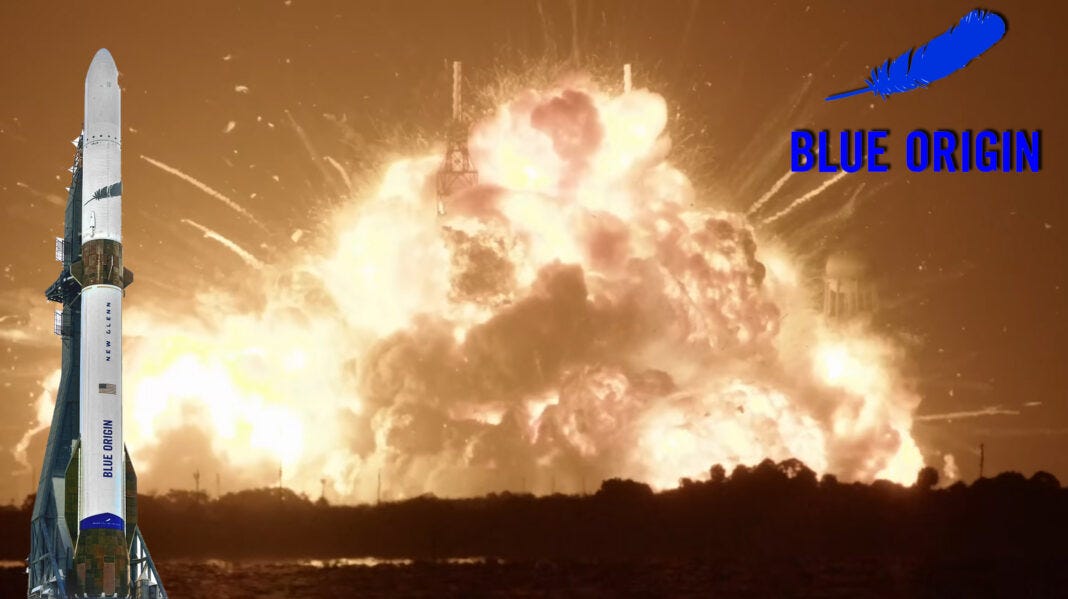
On May 28, Blue Origin’s New Glenn rocket exploded on the LC-36 launch pad during a static fire test. Unfortunately this could delay the Artemis Program, because Blue Origin’s Mk.1 cargo lander and Mk.2 Human Landing System (HLS) can only launch on New Glenn. Fortunately SpaceX has a fleet of reusable launch vehicle ready to fill the gap, so the race is still on with China, as the 2028 finish-line fast approaches.
Affected Missions
Blue Origin has 5 lunar lander flights, which could be delayed: -
Pathfinder 1 – Mk.1 cargo lander test, No Earlier Than (NET) late 2026.
Pathfinder 2 – NASA VIPER mission on Mk.1 lander, NET 2027.
HLS – Mk.2 crew lander test, NET 2027.
Artemis 3 – Mk.2 lander docks with Orion crew vehicle in Low Earth Orbit (LEO), NET late 2027.
CLV-1 – Astrolab Lunar Terrain Vehicle (LTV) on Mk.1 lander, NET early 2028.
Pegasus – Lunar Outpost LTV on Mk.1 lander, NET early 2028.
Unfortunately the Mk.1 and Mk.2 landers are both topped off with hydrogen propellant from New Glenn’s upper stage, so can’t launch on Falcon Heavy or Starship because they use different propellants. The ULA Vulcan has a hydrogen upper stage but lacks the lift capacity of New Glenn, which is designed for cislunar operations.
Community Support
NASA’s Administrator visited LC-36 to assess damage and offer their support: -
“We are going to take an active role alongside our partners, just as we did in the 1960s, to overcome setbacks, remove obstacles, and deliver the intended outcomes. NASA is committed to helping the Blue [Origin] team recover, continue to advance their lunar lander and get New Glenn back to launching as soon as safely possible.” ~ Jared Isaacman/X
SpaceX also offered their support and advice on how to proceed: -
“You have to first study and then precisely engineer the demo[lition] as there are many unknowns with the state of the infrastructure. You also want to do your best to save the Ground Support Equipment that is still good. A miss on a piece of steel mass/cg or unknown trapped pressure can quickly turn disastrous. The last thing you want to do is make a tough situation worse by getting someone hurt or worse. Cleanup has to be done with a sense of urgency, but extreme precision. It’s literally launch pad surgery.” ~ Kiko Dontchev, VP of Launch/X
In 2016 SpaceX experienced a similar explosion during the AMOS-6 static fire, which totaled the SLC-40 pad at the Cape. More recently in June 2025, Starship 36 exploded during a static fire, causing extensive damage to Masseys test site at Starbase Tx. While Blue Origin is a competitor, SpaceX supports anyone who shares their mission to open space, even the direct competition. For example: they helped OneWeb complete their internet constellation after Soyuz launches were discontinued, due to the Ukraine war.
How Long
“We will fly again before the end of this year. Gradatim Ferociter.” ~ Dave Limp, Blue Origin CEO/X
This is an aggressive target, considering SpaceX’s experience rebuilding SLC-40: -
“SpaceX went from the AMOS-6 failure to a new launch in 15.5 months. The actual construction part, following remediation and design, required 11 months.” ~ Ars Technica/Eric Berger
Note: SpaceX is renowned for fast work, and has a deep bench of technical employees at the Cape and Vandenberg, call them ‘the right staff...’
Realistically it could take a month to forensically examine the launch site, followed by a year to rebuild the pad and transporter, assuming there’s little damage to the ground support equipment. Then New Glenn must be recertified for NASA missions, which could require multiple test flights with non-NASA payloads. The last New Glenn flight failed due to a second stage problem, and the static fire failure originated from the booster, indicating they have multiple issues. Overall this suggests Blue Origin is effectively sidelined from Artemis, and the onus is now on SpaceX.
Why SpaceX
Increasingly SpaceX has become the fallback option to overcome space related problems: -
Astronaut rescue – SpaceX managed to safely return 2 astronauts (Butch Wilmore and Suni Williams), from the International Space Station (ISS), following the Boeing Starliner mishap.
Interrupted launch – in August 2023 the Antares 230 launch vehicla ceased production due to Russia sanctions. Northrop Grumman now uses Falcon 9 for its Cygnus cargo flights to the ISS, until the Antares 300 rocket becomes available.
Development delay – Firefly Aerospace is building a Medium Launch Vehicle (MLV) to carry their Blue Ghost lander to the moon, but MLV wasn’t ready for the first flight, so they used Falcon 9 to maintain schedule.
Given their flexibility and experience, SpaceX seems a safe pair of hands.
SpaceX Save
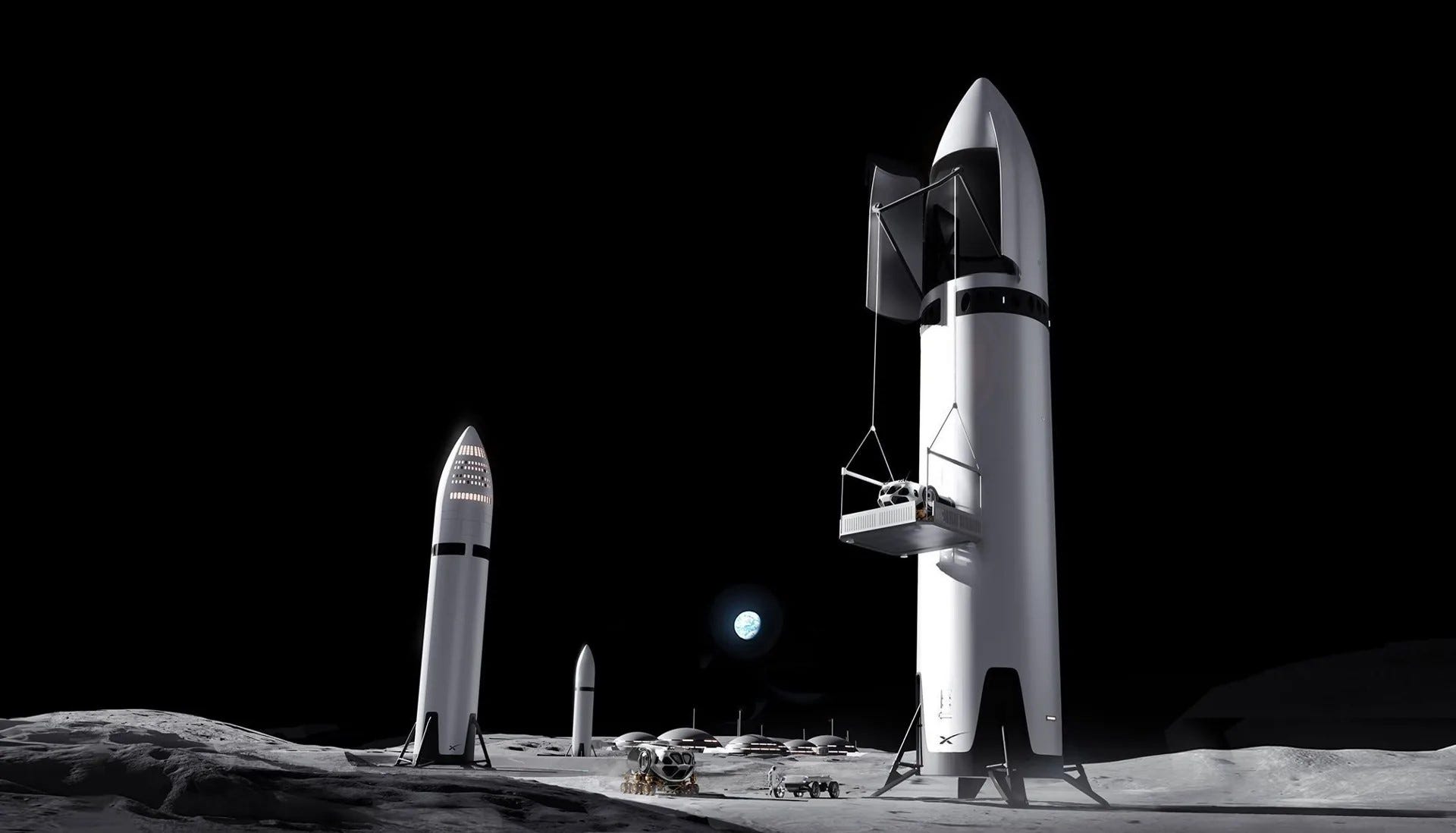
For the Artemis 3 mission in late 2027, NASA can dock the Orion crew vehicle with a Starship Human Landing System (HLS) in LEO. Coincidentally, SpaceX also plans to send a HLS to the moon in 2027 for a lunar landing test, so they could use the Artemis 3 HLS for this landing test, after refueling it in LEO. The HLS elevator is rated for 2 tons, more than enough to lower the 500kg VIPER rover to the lunar surface, or one ton vehicles like CLV-1 and Pegasus. Alternately one of the Commercial Lunar Payload System (CLPS) landers (i.e. Nova-D, Griffin or Apex 1.0) could land VIPER on the moon, if launched on Falcon Heavy. Unfortunately Pegasus and CLV-1 are too heavy for CLPS landers, hence will probably launch on Starship. Technically HLS has a 100 ton payload, which means it can transport 2 NASA astronauts and both LTVs to the moon, on a single vehicle.
It seems some destinies have an ineluctable gravity, that can’t be denied: -
“Starship will end up doing the whole Moon mission. Mark my words.” ~ Elon Musk/X
In Conclusion
NASA will have a tough time keeping Artemis on track but has a capable partner in SpaceX. Starship is now the critical path to the moon, fortunately its development is accelerating, with $930m spent in the last quarter alone. Pivotally LC-39A will soon be ready to launch Starship from the Cape, providing launch pad redundancy, reducing the overall risk for Artemis. In the final analysis, SpaceX’s head down charge for the line attitude, has scored plenty of touchdowns…
I don't see any pathway for launching New Glenn again this year. Mid 2027 at best. The entire Lunar architecture is now riding on SpaceX, for now, which relies on proving rapid reuse and cryogenic refeuling.
While I'm excited for the future and hopeful that we will see a manned Lunar landing in 2028, the odds are now against NASA. There is just too much work to do on Starship, too many unknowns.
They will get there, but maybe not as quickly as we would like.
Good piece, full of optimism. Let's not get bogged down with the unfortunate failure of Blue Origin and keep aiming for the stars. After all it's the advantage of a free market which allows competitors to push each other and themselves to achieve the goal (cheaper and faster).