
Moon Hail Mary
NASA course correct Artemis

The Moon is vital to space strategy and commerce, so NASA has to secure its position there without delay. In a bold move, it has proposed using SpaceX’s Starship to propel the Orion spacecraft to the moon, in order to mitigate problems with their Space Launch System (SLS). NASA must land before China, even if it means going around SLS.
Everything to Play For
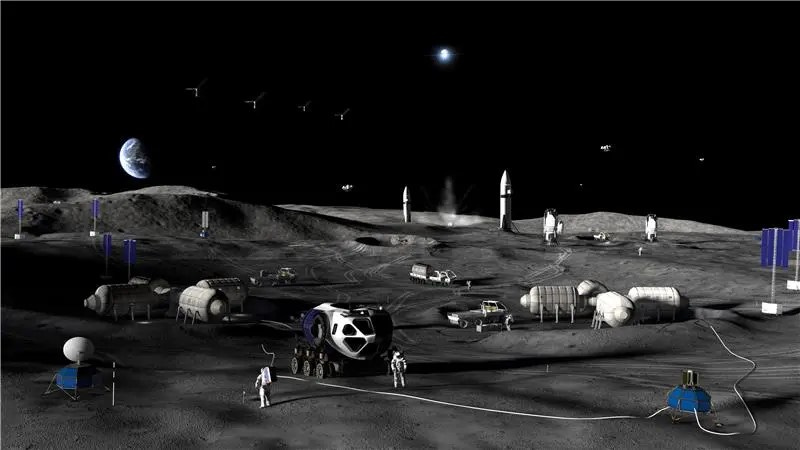
China should land on the moon in 2029, so NASA has scheduled their Artemis 4 and 5 missions to land in 2028, to secure the best site to build a moonbase. Both countries want to set up bases at the lunar south pole, unfortunately the number of suitable sites is limited. A large area of flat and boulder-free terrain is needed for initial landings, situated relatively close to the base-building site. Ideally the base should sit on polar high ground, known as peaks of eternal light, to receive continual solar energy. The raised rim of Shackleton Crater seems the best prospect, assuming the rim has collapsed somewhere nearby, to create a ramp down to the crater floor. Shackleton could contain millions of tons of volatile materials like water, methane and carbon monoxide/dioxide, essential raw materials for maintaining a lunar settlement. So a large flat area, close to a crater rim, close to a rim collapse...really restricts the number of suitable sites.
Stake in the Ground
“I want landers on the moon, at the south pole, on a monthly cadence starting at the beginning of 2027.” ~ Jared Isaacman/SpaceNews.com
NASA will use commercial robotic landers, originally created for the CLPS Program, to identify the best base-building site. Then a host of landers will focus activity there, essentially staking claim to the base area. These landers will also carry exploration rovers, designed to descend into nearby craters, to verify the quantity of volatiles available. For example: NASA’s VIPER rover should deploy in late 2027, to prospect the local area.
Increased Cadence
NASA has agreed with contractors to accelerate SLS delivery. Initially the Artemis 2 mission will launch this April, and loop around the moon with a crew of 4 aboard. Artemis 3 is scheduled for 2027, and primarily designed to test docking procedures between the Orion spacecraft and HLS in Low Earth Orbit (LEO). All being well, Artemis 4 and 5 will land astronauts on the moon in 2028, roughly a year ahead of China. Then Artemis 6 and 7 are scheduled the following year to begin base-building in earnest.
Commercial Contingency
“We are not going to sit idly by while schedules slip or budgets are exceeded. Expect uncomfortable action if that is what it takes.” ~ Jared Isaacman/Ars Technica
SLS has been plagued by delays and cost overruns, so NASA has created a workaround. If Boeing fail to deliver SLS on time, NASA will use the Starship Human Landing System (HLS) to push Orion to Low Lunar Orbit (LLO). Such a major programmatic change requires in-depth preparation, which explains the Artemis 3 mission to LEO. If for any reason SLS isn’t ready for Artemis 3, Orion could launch on a commercial vehicle. For example: New Glenn, Falcon Heavy and Starship have sufficient lift capacity to handle the Orion stack, comprised of the Crew Module, European Service Module and Launch Abort System. Once Orion docks with HLS, some propulsive tests can be performed to determine how this new propulsion technique affects both vehicles and astronauts. Similarly if SLS is unavailable in 2028, Artemis 4 and 5 could proceed on schedule using solely commercial launch vehicles and HLS.
Big Picture
NASA has an off-ramp for SLS, which should light a fire under prime contractor Boeing to deliver. Realistically SLS is the simplest way to reach the moon but NASA has prepared a contingency to preserve the schedule.
“Beginning with Artemis VI, the agency will transition from government driven missions to commercial launches (i.e. Starship or New Glenn or others).” ~ Eric Berger/X
SLS lacks the lift capacity to transport all the hardware and passengers needed to create a moonbase. Therefore NASA has to transition to more capable vehicles like Starship and currently preparing to pivot. No doubt some political lobbyists will oppose this transition, but NASA can’t be faulted if they use Starship to beat the 2029 deadline with China.
In Conclusion
Isaacman has taken the bull by the horns and applying maximum leverage to maintain NASA’s moon landing schedule. Artemis 3 should demonstrate commercial vehicles are a viable alternative to SLS, if it is delayed for any reason.
NASA wanted to build a moonbase since the 1960s and it’s finally going to happen. All it took was a more commercial approach by their new entrepreneur administrator.