
How SpaceX Will Pay for the Moon and Mars
New space destinations mean mega-ROI

To achieve anything meaningful in space, like building a Super Heavy Lift (SHL) rocket, requires billions, and to achieve anything truly momentous, like constructing a moon or Mars base, requires trillions. SpaceX has spent just shy of $10 billion to develop their SHL Starship but to create new space destinations they need a hundred times more, comparable to a sixth of the US federal budget. Sounds a tall order, until we project their future revenue...
Starlink/Starshield
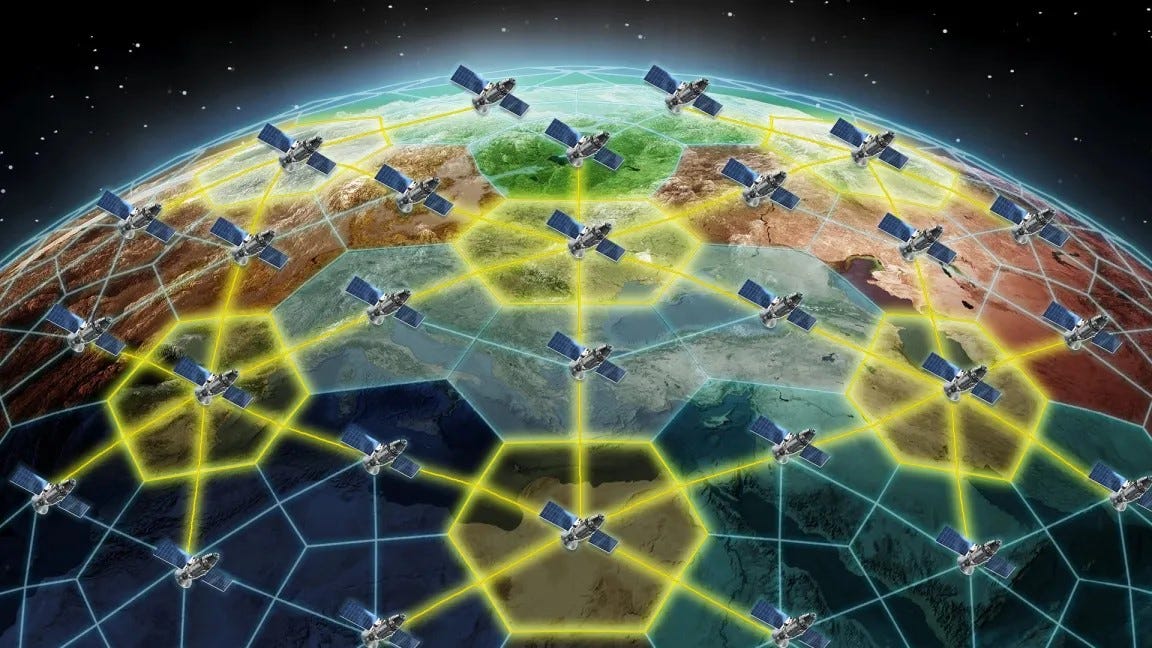
The Starlink constellation is like something from science fiction, currently comprised of ~8.500 satellites, twice as many as all the other satellite constellations combined. The revenue SpaceX receive can be broken down into three areas: -
Global Broadband – the Total Addressable Market (TAM) to supply broadband is ~$1tn, of which SpaceX should receive at least half, due to Starlink’s high bandwidth, low cost and global coverage. Projected SpaceX Revenue: $500bn p.a.
Cell Service – the TAM for cell service should exceed $2.2tn by 2032, and SpaceX should receive at least a third, due to their global coverage. Projected SpaceX Revenue: $733bn p.a.
Starshield Constellation – SpaceX also build, launch and operate Starshield satellites for the National Reconnaissance Office. These surveillance satellites can track potential targets on the ground or in flight making it invaluable for early warning. Interestingly the revenue derived from Starshield is almost a rounding error compared to Starlink, suggesting this is a strategic move by SpaceX. Projected SpaceX Revenue: <$1bn p.a
Golden Dome
The White House want to construct a network of sentinel satellites to intercept ballistic and cruise missiles during the launch phase. Cost estimates vary: -
“President Trump in May said it would cost $175 billion over three years. The Congressional Budget Office projected between $161 billion and $542 billion over two decades. [Defense analyst Todd] Harrison’s “robust all-threat defense” scenario came in at $3.6 trillion over the same time period.” ~ Spacenews,com
No doubt the DoD aim to reduce costs to make the program more digestible for congress. Initially 500-1,000 satellites are needed to complete the missile sensing constellation, though this number would likely grow in the future. If Starshield satellites are used for this role, that should minimize development cost because they are already in production. Around 200 interceptor satellites are also required and SpaceX could supply the satellite bus, due to their cost efficiencies from manufacturing at scale.
SpaceX has the lowest launch cost due to partial reuse, and this cost should decline further with the introduction of Starship, their fully reusable SHL vehicle. Arguably SpaceX are the only company capable of launching at scale, again due to reusability, making them a shoo-in for Golden Dome work.
Technically SpaceX already operate 2 mega-constellations in Low Earth Orbit (LEO), so adding another 1,200 satellites for Golden Dome would minimize operating costs. Starshield relies on the Starlink constellation to relay data, if Golden Dome is added that should elliminate any compatibility issues.
Lastly the White House want to complete the first tranche of Golden Dome in 3 years, to avoid the program being canceled by the next administration. Only SpaceX can move this fast, the company was built for fast development and already laid most of the groundwork. If interceptor missiles are used they would likely come from a legacy defense company hence take more time to field. However, if some kind of energy weapon is used instead, SpaceX has studied using high energy lasers for deep space communications, so they could field something in the limited time available.
Overall SpaceX should play a vital role in Golden Dome from start to finish. Reportedly they received $1.8bn to develop, launch and operate the initial tranche of 200 Starshield satellites, which suggests SpaceX could reasonably expect ~$10bn for Golden Dome work. However, to deploy enough satellites to reliably intercept missiles globally, the constellation would have to grow to 10,000 or more… Projected SpaceX Revenue: $400bn
Space Force
If Golden Dome removes the threat from ground launched missiles, new weapons could be launched from space, originating anywhere from LEO to the lunar surface. While the Outer Space Treaty prohibits Weapons of Mass Destruction (WMD) in space, some weapons, such as tungsten rods dropped from orbit or mass drivers on the moon, fall into the gray zone.
“But as nations move out, and as the economy grows between here and the lunar surface, and as you look at key terrain for the defense of our nation, I think it’s an area that will be significant as we move forward… I do see that there may be a role for [Space Force] Guardians that will be in space. So I think that will happen in the...career timeframe of the Guardians that are coming into service right now.” ~ Chief of Space Operations Gen. John W. “Jay” Raymond
No doubt the US would have to operate a highly mobile and capable fleet of spacecraft to detect and counter threats from space, consisted of either manned or autonomous vehicles, preferably a mix of both. Starship seems an ideal candidate to become a drone carrier, due to its size and orbital refueling capability, which would allow extended wide ranging patrols. SpaceX aim to build one Starship a day and Starbase costs $1m a day to run, so SpaceX could build drone carriers at affordable cost. However, outfitting, personnel training, flight certification and launch services would far exceed any construction cost, likely exceeding $2bn per vehicle.
Once in operation each carrier would require extensive services, i.e. secure laser communications, orbital refueling, materiel resupply, computer updates etc. Overall delivering such services could cost at least $10m per day per vehicle, so an active fleet of twelve comes to more than $44bn per year.
Periodically these carriers would have to return to the Cape, then be refurbished, refitted and recertified before deploying back to space. This suggests another 12 carriers would have to undergo this lengthy process on the ground, to maintain 12 active carriers in space.
Hence to build a fleet of 24 carriers, Projected SpaceX Revenue: $48bn
And to maintain this fleet in operation, Projected SpaceX Revenue: >$68bn p.a.
Artemis Base
China wants to build a lunar base by 2035, to match NASA’s plan to establish a base at the lunar south pole. However, NASA will require commercial contractors to construct this base, because of cost constraints.
“Developing a Moon base to support future space exploration requires the transport of large amounts of cargo to the surface of the Moon. Starship is designed to carry these building blocks, further enabling research and human spaceflight development. SpaceX is supplying the lunar lander which will return astronauts to the lunar surface for the first time in 50 years under NASA’s Artemis missions.” ~ SpaceX
Likely SpaceX will share construction cost for this base, similar to the way they currently fund Starship development (SpaceX outlay ~$10bn, of which NASA will contribute $2.9bn). NASA and SpaceX both want to increase commercial space activity, and the best way is to create new space destinations. Constructing a reasonable size base will require 50 Starship flights minimum, and SpaceX currently charge $1.15bn per flight, which includes ~10 refueling flights. Projected SpaceX Revenue: $58bn
A lunar base will enable a range of commercial operations, which entails large scale space transportation. Starship could ferry 100 people to the moon in fairly close quarters, and if SpaceX charge $50m per berth (reasonable), the overall flight cost is $5bn. Normally SpaceX charge a comparable amount for cargo flights, so assuming one cargo Starship is required to supply 100 people for 6 months, that should produce another $5bn. Long tours are to be expected at the lunar base, which suggests 4 Starship flights would be required per year. Projected SpaceX Revenue: $20bn p.a.
Seems high for NASA but costs would be shared with commercial operators and Space Force, who would provide personnel for base security.
In Conclusion
SpaceX could reasonably receive more than $500bn from Golden Dome, Space Fleet and Artemis Base work. More importantly their annual revenue is projected to exceed $1tn, at close to software margins.
Many suggest Mars colonization is unprofitable but SpaceX is willing and able to bear the cost. In reality money is the least of their concerns, given the unrivaled capabilities of Starship.