
Commercial Space Race
NASA vision becomes reality, cue second space age

NASA has long sought to create a commercial ecosystem in space, where companies compete to operate in the high frontier. Now this vision is transforming into reality, with numerous commercial enterprises vying for their place among the stars, following the stellar example of SpaceX. This transformation won’t be easy or comfortable for legacy interests but it promises to launch us to the next level, creating an organically sustainable second space age.
Commercial Space Stations
Space access has long been the bottleneck for commercial space operations, such as space research and microgravity manufacturing. Doing anything on the International Space Station (ISS) involves many bureaucratic hurdles, in order to accommodate NASA plans and safety measures. However, this will change with the advent of commercial space stations, which must ensure easy/low cost access to grow their business.
SpaceX demonstrated low cost launch is possible with reusable launch vehicles and promise to drive the cost even lower with Starship. Following their example, many companies like Rocket Lab, Blue Origin and numerous China startups are aggressively pursuing reusability, ensuring strong competition to lower launch prices. When commercial stations appear in the early 2030’s, multiple reusable launch vehicles should be available, effectively removing the last major hurdles to commercial space operations. And if there’s a gap in space station availability, SpaceX could offer Starship at commercial rates, although it can range much farther than Low Earth Orbit (LEO), for anyone interested in deep space research.
Where there’s Money there’s Many
“Perhaps an interesting milestone: SpaceX commercial revenue from space will exceed the entire budget of NASA next year. SpaceX revenue this year will be ~$15.5B, of which NASA is ~$1.1B.” ~ Elon Musk/X
There’s enormous profit to be made from space, SpaceX expects ~$12bn in revenue from Starlink alone this year and this could easily double next year... After deploying thousands of Starlink satellites they effectively own the 550km orbit, arguably the most valuable space real estate going due to its proximity to Earth. Now there’s a gold-rush to acquire adjacent orbits by competitors, like Amazon and China SatNet, who have begun to launch their own mega-constellation and secure a similarly profitable orbit for perpetuity.
Some might question what these companies will do with this incredible amount of money, but the only way is up... SpaceX reinvests its profits to develop new space technologies like Starship and improve Starlink systems. For anyone to compete with SpaceX they must follow a similar strategy and use the majority of their profits for space systems development.
Commercial Space Race
Overall there’s plenty of opportunities in space, for those brave enough to pursue them. For example: the DoD and satellite companies are willing to pay to dispose of defunct satellites, and commercial space stations will pay a premium to anyone able to deliver 3D feedstock. If some enterprising company can retrieve these unwanted satellites and separate them into high grade materials in space (through disassembly or microgravity refining techniques), they can expect to be paid twice and create a niche service.
Moon Rise
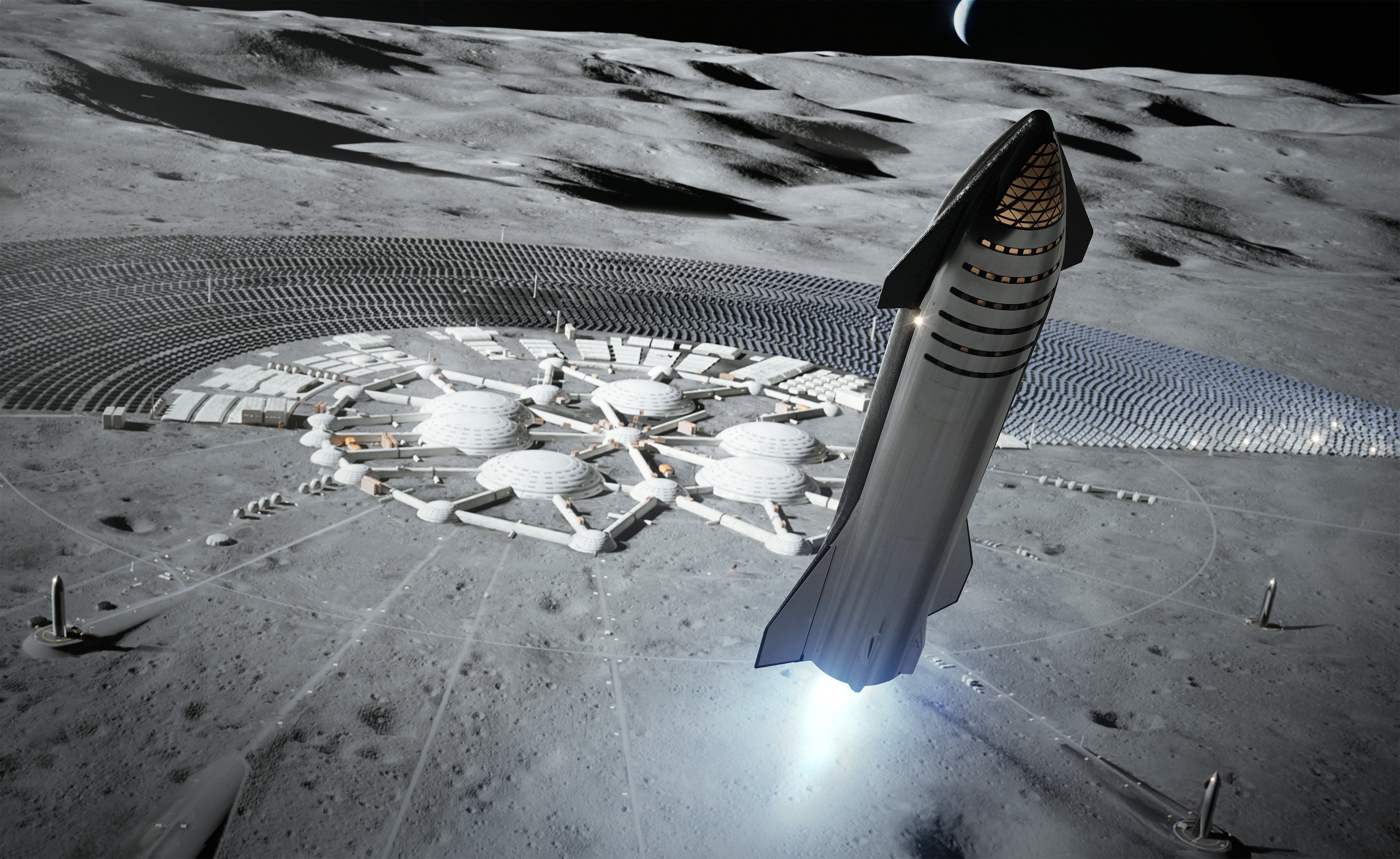
Many have realized the next big business opportunity is the moon, driven by geopolitical competition and abundant natural resources. NASA must land Artemis astronauts on the moon this decade or risk China staking claim to the South Pole-Aitken (SPA) basin. The SPA region contains millions of tons of ice in permanently shadowed lunar craters. These vast reserves of water can be processed into rocket propellant using solar energy, which is stronger on the moon (1.37 kW/m² compared to ~1 kW/m² on Earth at noon) and constant intensity at the poles. This rocket propellant will allow considerable mass to be launched from the moon, making commercial operations possible. The prospects for lunar mining are mouth watering: -
Helium 3 – used for quantum computing and likely to become a fuel for nuclear fusion in the future. Market value: $20bn/ton at present, possibly many times higher if used for nuclear fusion.
Rhodium – derived from metallic asteroids which have impacted the moon. Market value: $222m/ton at present, possibly higher when more applications are found for this extremely rare element.
Rare Earths – are found in iron rich magma deposits, similar to the maria covering the near side of the moon. Market values range from $2,960 to $3,600,000/ton, though their value on the moon could increase due to demand for advanced materials.
Scandium, for example, is strong as titanium, hard as ceramic, light as aluminum, corrosion resistant, with a high melting point. Alloys which contain scandium are extremely durable, hence ideal for spacesuits, habitats and spacecraft; a true space age material.
Early access with CLPS
NASA has decided to match China’s early robotic missions by contracting numerous commercial landers through the Commercial Lunar Payload Services (CLPS) Program. This allows space companies and NASA to share the development cost of new landers, while maintaining healthy and friendly competition. NASA’s endorsement has allowed CLPS companies to access significant investment and attract commercial customers, who wish to send private payloads to the moon. So far only Firefly’s Blue Ghost has successfully landed, with good attempts made by Astrobotic’s Peregrine and Intuitive’s Nova-C landers, although partial failures are necessary for companies to gain experience. No doubt their commercial customers will start lunar prospecting, and establish safety zones to minimize interference, allowing extraction operations to begin in parallel with building a lunar base.
Moon Base
“Developing a Moon base to support future space exploration requires the transport of large amounts of cargo to the surface of the Moon. Starship is designed to carry these building blocks, further enabling research and human spaceflight development. SpaceX is supplying the lunar lander which will return astronauts to the lunar surface for the first time in 50 years under NASA’s Artemis missions.” ~ SpaceX
Large landers like Starship and Blue Moon will supply the bulk of goods and people to the lunar settlement, but smaller delivery vehicles will also be required like CLPS landers and Hakuto-R. The bulk transport might arrive once every six months initially (due to the refueling process which requires many tanker flights), so if something is urgently needed it will be sent on a smaller lander. Overall this should allow good competition in the space supply sector and ensure a diverse lunar economy. Small landers could even be reused if they are returned to Earth on bulk carriers, making them far more economic and ecological.
Commercial is Key
Companies build almost everything on Earth due to commercial efficiency, so likely they will be used to build a lunar settlement. NASA and Artemis partners will be the first customers, followed by Space Force to provide security.
“But as nations move out, and as the economy grows between here and the lunar surface, and as you look at key terrain for the defense of our nation, I think it’s an area that will be significant as we move forward… I do see that there may be a role for [Space Force] Guardians that will be in space. So I think that will happen in the...career timeframe of the Guardians that are coming into service right now.” ~ Chief of Space Operations Gen. John W. “Jay” Raymond
Lunar personnel will require considerable services i.e. air, heat, light, food, accommodation, and lots of power. Again companies are the best way to supply these services at scale, so a lunar settlement would be a cornucopia of commercial opportunity, particularly as demand becomes more sophisticated (e.g. local media, custom manufacturing, express delivery etc).
Outposts will also be established inside permanently shadowed polar craters, which remain at deep-cryo temperatures, making them ideal for cryogenic propellant production and ice mining. A reasonable amount of carbon is also found in these craters, in the form of frozen carbon dioxide/monoxide, enough to make all the methane propellant needed to operate Starship for centuries. Space Force will probably patrol the cislunar area, hence rely on lunar propellant to remain operational, making them an anchor customer.
Initially the settlement’s spaceport would be located nearby the base, somewhere within easy transport distance for heavy cargo. However, once propellant production is established it would be logical to land spacecraft in a polar crater, to make refueling more efficient and minimize any risk from ejecta for the growing lunar settlement.
10X Mars
All the technology developed for the lunar settlement can be used for Mars, although the Martian settlement needs to be much larger due to its remoteness from Earth. Bulk transports will arrive once every 26 months, so settlers must have all the facilities needed to survive indefinitely, if transport fails for any reason.
“To have a self sustaining city on Mars, now you got to say: how can you get a million tons to Mars. Literally a million tons.” ~ Elon Musk/CBS
Perforce Mars settlement will be fully commercial, because congress probably couldn’t afford it, and if somehow they did, their longterm support isn’t guaranteed. Elon Musk intends to go to Mars, which suggests many will follow him to seize the opportunity. The local economy on Mars will be vibrant, driven by this influx of young settlers, many of whom will be entrepreneurs and/or engineers. Similar to the moon, Mars settlers will demand more services, making for endless commercial opportunities in this ever expanding frontier.
In Conclusion
Commercial space companies only require some kind of endorsement from NASA or the DoD to make them attractive to investors, following the success of SpaceX. NASA could be viewed as the first stage, and commercial the second stage that takes us to sustained space operations.
Competition is inevitable between the US and China, hence acts as a forcing function on space development. This accelerated pace should provide the best chance for longterm success, because it ensures focus and consistent results, similar to the Apollo Program. Brave new worlds await as commercial space lifts us to the next level.
Commercial space stations look likely to be what replaces the ISS after 2030.
The cost of launching and operating them, enabled by partially reusable rockets, will make them, for the first time, a viable business prospect.
The first step is to enable millions of humans living and working in space. Then move toward becoming a multi-planetary species.
Crazy to think that humanity may reach a Type II civilization on Robert Zubrin’s scale, within our lifetimes.