

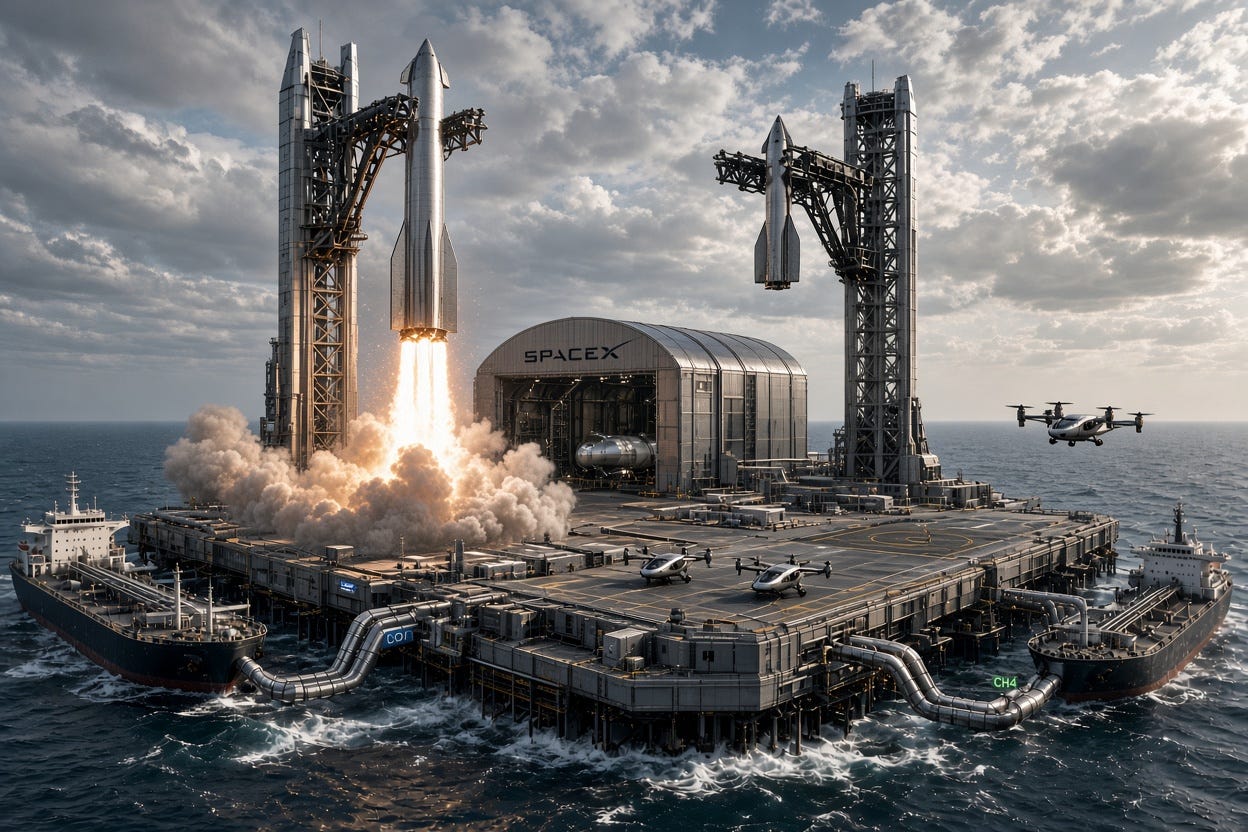
SpaceX has long pursued floating spaceports for Starship missions and now close to realizing that ambition. Instead of launching from a few niche locations, space transport will become a global service accessed by anyone. Making humanity multiplanetary is a huge undertaking, which will become a worldwide effort.
Phobos and Deimos
In 2020 SpaceX purchased 2 oil rigs, which they named Phobos and Deimos after the small moons of Mars. Then they began to convert them into floating spaceports to expand the launch capacity for Starship.
“SpaceX is building floating, superheavy-class spaceports for Mars, moon & hypersonic travel around Earth,” ~ Elon Musk/X
However, by February 2022 SpaceX concluded these rigs were “not the right platform,” and subsequently sold them on. These semi-submersible platforms were relatively small compared to Starship, hence could only support a single launch tower and limited propellant storage, and SpaceX had far larger ambitions...
New Start
SpaceX is now more experienced operating Starship, hence has a better idea how to build a floating spaceport. Regulatory hurdles like Environmental Assessments (EAs) have been cleared and the Bureau of Ocean Energy Management (BOEM), who regulate offshore rigs, has been informed: -
“High cadence, cost effective launch and recovery, including offshore platforms is essential to expanding American presence in space and growing a vibrant commercial space economy.” ~ Owen McDonough, SpaceX Senior Manager Government Affairs
The BOEM’s area of responsibility includes the Outer Continental Shelf (OCS), so SpaceX confirmed they want to use it for spaceport operations: -
“SpaceX supports use of the OCS for offshore space launch and reentry, including purpose-built and repurposed facilities for launch and catch operations of reusable spaceflight operations.” ~ Owen McDonough, SpaceX Senior Manager Government affairs
While SpaceX didn’t detail these Spaceports, their existing EAs give a good idea where they would be located.
Americas First
“Starship/Super Heavy orbital mission would include a Starship landing after Starship completes its orbital mission...Starship would land vertically at the VLA [Vertical Launch Area] or on a floating platform in the Gulf of Mexico or the Pacific Ocean and go into an automated safing sequence.” ~ FAA Programmatic Environmental Assessment
SpaceX already land Starship boosters in the Gulf east of Starbase, which suggests the first floating spaceport will operate there, to take advantage of their local launch facilities and north coast shipbuilders. However, SpaceX also want to land Starship in sea areas adjacent to:-
Cape Canaveral
Vandenberg Space Force Base
Hawaiian Islands
Easter Island, off Chilean coast
Essentially SpaceX is taking an Americas first approach for these spaceports before going global.
Global Reach
“It’s no secret that we intend to launch Starship a lot, targeting thousands of flights per year. That cadence will require the ability to launch from many different locations, so we are constantly exploring to find viable sites to expand Starship operations in the future, both domestically and internationally.” ~ SpaceX/X
Building self-sustaining cities on other worlds will require a multitude of floating spaceports around the globe to provide launch opportunities every hour. Fortunately SpaceX can deploy these spaceports relatively close to coastal cities, allowing them to be used for commercial passenger transport.
“Most Starship spaceports will probably need to be ~20 miles / 30km offshore for acceptable noise levels, especially for frequent daily flights, as would occur for point to point flights on Earth” ~ Elon Musk/X
The US Space Force has shown strong interest in using Starship for materiel transport, so these floating spaceports will serve three customers, SpaceX, commercial passengers and Space Force. Effectively these 2 external customers will fund and support SpaceX’s expansion of their global network.
Spaceport Schema
This distributed network of land and sea based spaceports will allow a fleet of Starships, (including passenger vehicles, orbital Tankers and materiel transports) to shuttle quickly around the world – or even beyond and return. However, if an issue occurs with the catch tower, these flights could quickly backup. Hence SpaceX will need multiple launch/catch towers at each spaceport to provide redundancy and increase operational capacity (Starbase will have 2 towers, Cape Canaveral 3 and Louisiana has room for 100). This suggests floating spaceports will have at least 2 launch/catch towers to ensure one is available to catch arriving Starships, despite any issues.
Normally propellant storage tanks are located as far as possible from the launch area – doubly so for landings. Floating spaceports will be cramped, so likely dispense with propellant storage tanks, and have liquid methane and oxygen tankers supply the platform from a safe distance. This would leave more space for a Starship hangar, passenger terminal plus landing pad for electric shuttle aircraft.
Ideally there would be no permanent crews onboard these propellant ships or platforms; steering/station keeping would be managed via Starlink, and maintenance tasks handled by autonomous/teleoperated androids.
In Conclusion
SpaceX look far beyond the launch business and intend to change our entire culture. Operating a worldwide network of coastal spaceports will put humanity on a different level and hopefully bring us closer together. For any other company this would be fantasy yet SpaceX continues to surprise us. Their deliver might be late, but certainly worth the wait.