
End of Human War
New technology alters gain vs loss equation for armed conflict

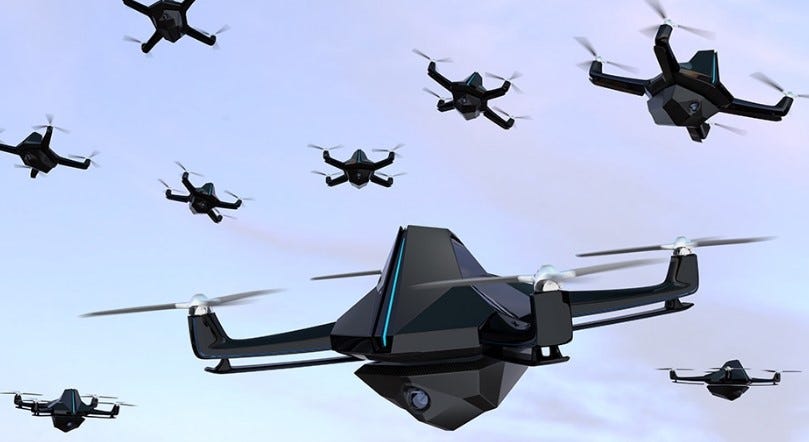
War is a constant thread through human history but constantly changing due to the advance in technology. Drones are the new wonder-weapon which increasingly make humans redundant on the battlefield. Hence future conflicts will be weapon system vs weapon system, with the best tech take-all.
Steppe Change
In most wars Russia relies on numbers to overwhelm the opposition, but Ukraine’s First Person View (FPV) drones outnumber Russian soldiers 70 to 1. The economics are stark, Russia offers ~$21,500 to enlist new recruits, whereas a standard FPV drone costs Ukraine $300-$700 to produce. This cost advantage extends to sea warfare, Ukrainian Naval drones and missiles have made the Black Sea impassible to the Russian fleet, which now remains in port. For Operation Spider Web, Russian truckers were paid to transport mobile cabins to military airfields in the Russian interior, then Ukrainian drones launched from the roofs, disabling ~10% of their strategic bombers in one fell swoop. Currently Ukraine is developing long range carrier vehicles, able to deploy FPV drones or missiles in any theater, land, sea or air. Even the undersea isn’t safe, as they have begun to operate submersible drones.
For ground assaults, Ukraine relies on heavily armed Uncrewed Ground Vehicles (UGVs), supported by surveillance and attack drones. Russians who survive the initial assault often surrender to these unmanned vehicles, and Ukraine only uses troops to secure basements where holdouts are hiding. Given these weapons’ effectiveness, Ukrainian servicemen mostly operate far from the contact-line, something made possible by ubiquitous broadband supplied by SpaceX’s Starlink. However, Starlink access has been removed in Russia, so they mainly rely on troops to fight machines…
Countermeasures are increasingly hard to come by, given the advance in technology. FPV drones use frequency hopping, making them difficult to jam except at short range, then they employ AI to home-in on pre-selected targets. Some drones are controlled via a strand of optical fiber, which Russian ground troops try to cut with scissors – but are not always successful. Counterwise, Ukraine has developed interceptor drones and they constantly hunt for Russian FPV operators with long range weapons.
Machine vs Machine
“Locally autonomous drone warfare is where the future will be, It’s not ‘I want the future to be this’ – it’s just, this is what the future will be.” ~ Elon Musk/BFBS Forces News
Given their effectiveness, troops will increasingly be replaced by machines on the front line. Then as these machines pose the greater threat, they must be dealt with first. Hopefully this should reduce military and civilian casualties, assuming a defeated nation surrenders after its drone defenses are overrun. Strange new world where military machines prioritize eliminating other machines over people.
Drone Drops
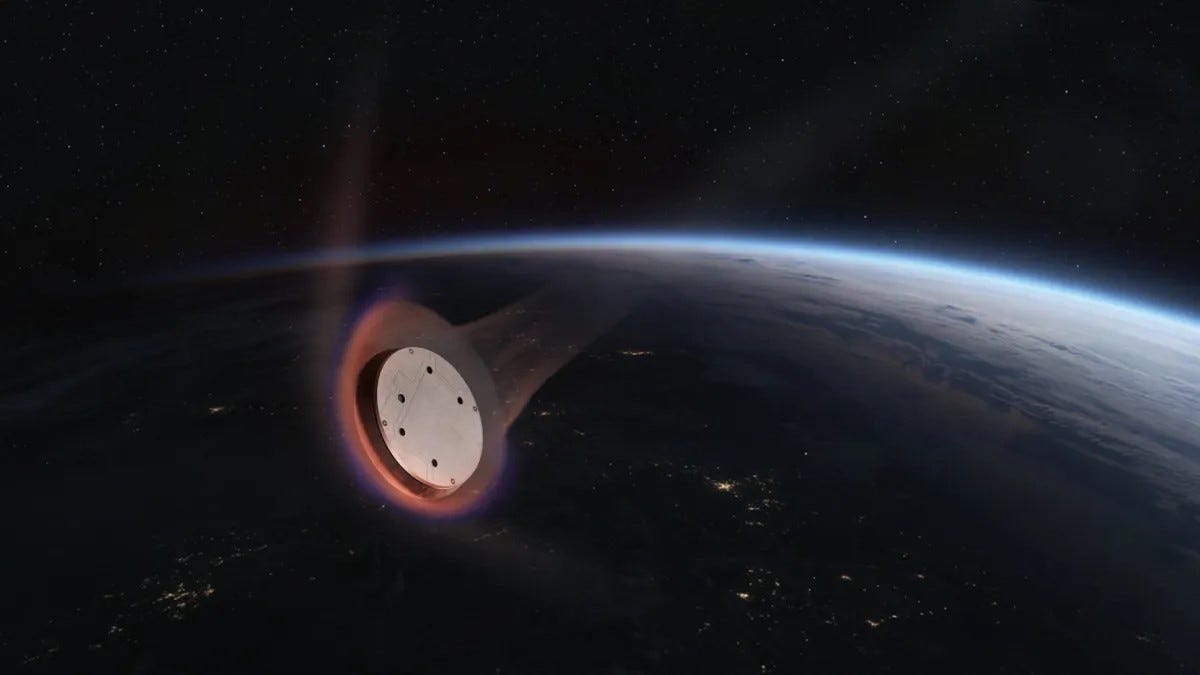
SpaceX has completed the first test of its Starfall vehicle, designed to return goods from space. However, demand for space manufactured goods is limited, so these reentry vehicles are more likely to be used to deliver military materiel.
“Starfall also has defense applications, and SpaceX is working in conjunction with the military on the program.” ~ Los Angeles Times
Each Starfall vehicle can carry 1,000kg of cargo which implies 1,000 rotocopter drones could be sent anywhere in the world in less than an hour, on one vehicle.
Less Fuss less Muss
“In the event of conflict or humanitarian crisis, the Space Force will be able to provide our national leadership with an independent option to achieve strategic objectives from space.” ~ General John Raymond, Chief of Space Operations/Spacenews.com
During the recent Middle East conflict, 69 Iranian munition storage sites were successfully attacked, blocking the tunnel entrances to these underground bunkers. However, Iran managed to unblock most of these tunnels, which allowed them to continue the war with their undamaged drones and missiles. By contrast if Starfall had been used, a swarm of AI drones could have flown deep inside the underground storage areas and destroyed any internal doors or impediments with high explosives, carried by the first wave. Once inside the main storage area, the swarm would make short work of any munitions, potentially ending the war in days instead of months. The whole world suffered exorbitant fuel prices and economic woes because of this protracted conflict, something which could have been avoided if Iran’s strategic weapons had been eliminated on day 1. No doubt their neighbors would also breath a sigh of relief knowing Iran could no longer attack them with nuclear missiles.
Starfall Practicality
Some suggest a sophisticated air defense system would make light work of any Starfall reentry vehicles. However, each vehicle weighs 3.1 tons when fully loaded, which suggests 30 could be launched by Starship Version 3 or 60 on Version 4. SpaceX will have 5 Starship launch mounts in the near future, which suggests they could deploy 300 Starfall vehicles at once, saturating any air defense system. Each vehicle will reenter at ~mach 25, making it difficult to intercept, even by advanced air defense systems. In addition, the vehicle would be surrounded by ionized plasma during descent, which should mask it from tracking radar. Currently Starfall has a relatively slow ground approach because they use parachutes to land, although these could easily be replaced by hypergolic thrusters, to enable a combat approach. For well defended areas, waves of rotocopter drones could be deployed throughout the descent, ensuring hundreds survive even if the carrier is intercepted closer to the ground.
In Conclusion
War is an unfortunate reality but bad actors like Iran could be reigned in with little difficulty in the future. Instead of sacrificing people, machines would become the primary casualties, something far more acceptable, at least to most ordinary people.
Overall this could lead most countries to become less belligerent, considering the prospect of a drone assault. Nuclear weapons were a technical marvel in their day but are now just another a drone swarm target.
Succinctly: if nukes are hammers, then drones are scalpels.